






Reviewed by NEAL GENDLER
Some Israelis might say nothing has gone wrong.
But the premise of Omer Bartov’s book is that much is wrong, particularly as summarized in an introduction called “From Liberation to Oppression.”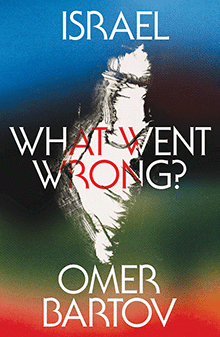
Bartov asks: “How is it possible that a state founded in the immediate aftermath of the Holocaust stands today credibly accused of perpetrating large-scale war crimes, forcible displacement of civilian populations, and crimes against humanity?”
Are those accusations credible? Views differ.
One possible answer is that a century of killing of Jews and wars to drive them out of Israel could not help but harden many hearts.
Israeli-born Bartov, a veteran of the 1973 Yom Kippur War, who is Dean’s Professor of Holocaust and Genocide Studies at Brown University, neither denies nor minimizes the horrors of Hamas’ Oct. 7, 2023, invasion.
But he questions the nature of Israel’s response.
Even more usefully and quite credibly, he examines changes in Israeli society and governance. He criticizes Israel’s lack of a constitution, which causes problems in governance, and Israel’s current government and prime minister.
That’s solid reading that fits well with reporting in daily English-language editions of mainstream Israeli newspapers. Those who read and see or hear only U.S. media accounts of Israeli events would learn enormously from Bartov’s book.
He’s particularly sensitive about Israel’s treatment of the Arabs under Israeli occupation — descendants of those who rejected the U.N. plan for sharing the expiring British Mandate.
“Told that we were the first generation of our people’s resurrection, we never questioned our presence, existence, and future in Israel,” he says.
He cites “colonial views of Palestine as an empty space.” Yet, over time, “some of us became increasingly aware that our resurrection had come at the price of another people’s catastrophe.”
That’s part of his views of the Palestinian Arab problem. Near the end of the book, he gives a potential solution from scholar Dahlia Scheindlin: a confederation of independent Israeli and Palestinian nations with open borders, rights of permanent residence in each other’s nation and cooperation on shared concerns such as public health, natural resources, security and the economy.
He says that the occupation of Judea and Samaria “has dehumanized the occupied and occupiers alike.” He says settlements have created “an apartheid regime,” and he claims that the Shoah caused Jews fear of extermination that leads to “no obligation to accept any international norms.”
That stunning claim is in keeping with Bartov’s criticism of the extent of war destruction in Gaza; but if he says anywhere that buildings were destroyed because Hamas was operating or shooting from them, I must have missed it.
Bartov acknowledges that “Judeophobia, now commonly referred to as antisemitism, has a long and vile history.” Later he writes: “Antisemitism cannot be dismissed as marginal to the Holocaust.”
But he says that “defining criticism of Israel as antisemitic is the best way to help the current Israeli leadership practice unchallenged extremist, racist policies.”
Again, views may differ, but it seems clear that Israel “is now the best excuse for antisemites everywhere.”
One area for argument, even as it’s part of his academic title, is Bartov’s repeated assertion that Israel’s war in Gaza is genocide.
He presents definitions of genocide that are broader than many of us may think. For example, the 1948 U.N. Genocide Convention definition ranges from killing members of the group — which Israel certainly did — to inflicting conditions of life calculated to physically destroy the group “in whole or in part.”
Two U.S. dictionaries offer shorter, simpler definitions that describe the Shoah’s intent — but not the Gaza war. Merriam-Webster: “the deliberate and systematic destruction of a racial, political, or cultural group.” American Heritage: “the systematic, planned extermination of an entire national, racial, political, or ethnic group.”
The word genocide was invented in 1944 by Raphael Lemkin, a Jewish refugee from Poland who defined it as “the destruction of a nation or an ethnic group” by actions with “the aim of annihilating the groups themselves.”
That’s what Nazi Germany planned. It managed to kill around 33 percent of the world’s 18 to 19 million Jews — all but about 500,000 of those who came under German control. Hamas’ claim of 73,000 deaths — apparently including deaths from any cause — is 0.0365 percent of Gaza’s population of 2 million.
No death is insignificant, but if Israel is attempting genocide, numbers suggest that its very competent armed forces are doing a very poor job of it.
***
Neal Gendler is a Minneapolis writer and editor.
(American Jewish World, July 2026)