




Reviewed by NEAL GENDLER
Joyride is a perfect title for writer Susan Orlean’s new book.
Not only has her life and work been filled — mostly — with joy, but reading the book is a joy.
It very engagingly summarizes a career from a startup Oregon magazine to Vogue, Rolling Stone, The New Yorker and now nine books.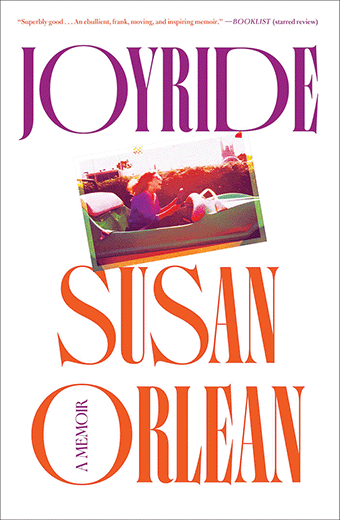
One book, The Orchid Thief, became the basis for the 2002 movie Adaptation, directed by Spike Jonze.
Exuberant and humorous, Joyride charms with stories of research experiences and the interesting, unusual people she encounters doing it. It’s hard to put down.
Orlean also tells us much about writing, describing the motivations, processes and “delight gotten from tacking a series of words in place that feels right.”
She’s had lots of practice, writing her first book around age 5: Herbert the Nearsighted Pigeon.
Writing “was something I wanted to do as soon as I realized it could be done,” she says. It “always felt natural to me.”
So was reading, with weekly walks with her Hungarian-born mother to a suburban Cleveland library. “I was the kind of kid who read until my mother told me to turn out the lights,” then read under the covers with a flashlight.
Her paternal grandfather came from Poland.
“My parents were defined by being Jewish,” she says. “It wasn’t a matter of observance or specifics; being Jewish was simply integral to who they were.” Hebrew school extended through high school.
Orlean’s professional path was shaped while in junior high by a Life magazine piece that followed a country doctor through a workday, from delivering babies to comforting dying patients.
“Reading that story was like hearing a thunderclap,” she says. “The content was fascinating.” More important was “realizing that a writer could produce a story about something routine… someone not famous” that could reveal “the truth about another life and nothing more” yet be interesting enough to be published.
“I knew then that using writing to satisfy my curiosity, and to illuminate the truth in the lives of others, was what I wanted to do.”
And that’s what she did, sometimes walking around New York to spot things that sparked her curiosity, research and writing. One of her stories was about an Ashanti king she met driving her in a cab.
“I kept looking for places to be published,” she says. “I had a relentless desire to expand my options and a constant yearning to be recognized, approved, acknowledged.” The New Yorker was an early goal.
Vogue offered access to free shoes sent for review and to low-price designer clothes sales. Her piece on being a hostess featured a cover photo of her “in hostess mode.”
Then she learned “The New Yorker was looking for new ‘Talk of the Town’ writers. This was shocking. It was as if the Vatican had put a listing for cardinals on Craigslist.”
Despite rejection of an earlier submission to The New Yorker, she got an interview and an assignment, in 1987, to write about how Benetton workers were trained to precisely fold clothes. Upon getting a call saying it would run, “I jumped up and down shrieking.”
Then it was more Talk of the Town pieces. Meantime, her marriage was deteriorating, and she was way behind on her first book, about Saturday night in America, eventually having to repay part of her advance and find another publisher. She kept traveling around the country, seeing what people did on Saturday nights, and asking them why. Research included a Saturday night with an alert crew in a Wyoming missile silo.
Saturday Night was a success. She was hired as a New Yorker staff writer, which had a startling change when Tina Brown came from Vanity Fair as editor.
Brown was determined to perk up the magazine with different types of pieces, says Orlean, who wrote both assigned pieces and ones she suggested. Her work took her into “worlds I might never have visited otherwise.”
One was traveling for two weekend performances with the Jackson Southernaires, five black gospel singers and their crew busing among small southern towns for loving, ecstatic audiences and sometimes-slender receipts. Her article — one of five in an appendix to the 368-page memoir — brings vividly to life a world about which most of us know nothing.
“I was deeply affected by what I saw: faded towns that lit up with sheer joy at the arrival of the Southernaires; animated crowds dressed in their best clothes; hours of magnificent music.”
Her 16-year marriage to an undemonstrative, withdrawn attorney ended. Later she would marry an investment banker and have a son.
Their temporary move to California to research and write Rin Tin Tin became permanent. That successful book took nearly 10 years, delving into the film and television history atop poring through the archived papers of owner Lee Duncan, who “kept every clip, every flyer, every press photo related to his dogs,” the original and its offspring.
“Reading them made me feel as though I had drilled inside a still-human life,” she says. “The day I reached the cache of funeral announcements for him in the archives, I cried.”
A tour of Los Angeles Central Library piqued her curiosity — and childhood memories — leading to The Library Book, another triumph of her ability to engage readers in an institution and people that most folks take for granted. But a memoir
“I resisted the idea of even saying the word memoir,” she writes late in the book, which has sold an estimated 250,000 to 300,000 copies.
“I wasn’t convinced I deserved that attention.”
***
Neal Gendler is a Minneapolis writer and editor.
(American Jewish World, June 2026)