





Reviewed by NEAL GENDLER
A world war and three generations later, the idea that the United States could become a nation ruled by Nazi-linked, Jew-hating fascists seems preposterous.
But things looked different during the Depression amid the growth of groups such as the Silver Legion (Silver Shirts) and the German American Bund with its swastika-studded rallies.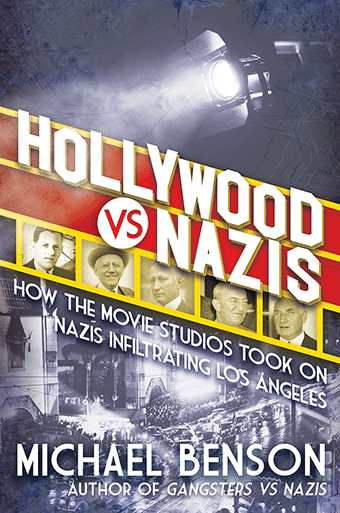
Many Americans, and especially Jews, considered such groups a real danger.
One Jew, successful Los Angeles lawyer Leon Lawrence Lewis, 45, decided to do something about it.
Hollywood vs. Nazis author Michael Benson describes Lewis, born in Hurley, Wisc., as a World War I combat veteran who’d been an executive in the Anti-Defamation League and B’nai B’rith. Lewis moved to Los Angeles in 1930. His client list included entertainer Eddie Cantor, who would help win Lewis’ acceptance by important movie figures.
Lewis became concerned about a Los Angeles group called Friends of New Germany, which had its first public meeting in April 1933.
Benson calls Friends “the first Nazis in Los Angeles,” with three themes for recruits: “Jews started the Great War, Jews caused the Great Depression, and Jewish Communists were in control of America.”
Friends wouldn’t long be the only Nazis in southern California, and Lewis became determined to fight them.
“He had no idea that this would be his life for the next eight years,” Benson says. He decided the best tactic was infiltration, an idea developed at an August 1933 meeting at the home of a judge and an advisory committee of some important members of the movie industry and a key player, entertainment lawyer Mendel Silberberg.
Despite the title, the movie industry plays only a supporting role in this book. It centers on Lewis’ recruitment of World War I veterans, their risky rise in Nazi-group ranks, his use of their information to thwart Nazi activities and his eventually successful efforts to obtain government investigations.
His agents, listed by a number or initials, had deep cover stories, but not Lewis, called by one Nazi “the most dangerous Jew in Los Angeles, the ringleader of all Jews here.”
(As if anyone could be the leader of “all Jews” anywhere!)
Lewis’ first recruit was John Schmidt, once a German soldier, then like Lewis a U.S. army officer, with a disarming appearance: “round and soft,” but tall with blue eyes and blond hair.
He fit well into Friends and brought in his wife Alyce for secretarial work. She was Agent 17.
The agents became enthusiastic members of the fascist groups, developing trust and even friendships with leaders. Some, like Schmidt, would have couples’ dinners with leaders and wives.
Only two agents were Jewish — William Conley and his wife Emma. Conley got an undercover Los Angeles policeman to monitor Friends gatherings.
One Friends big shot, Dietrich Gefkin, joined the California National Guard, planning to steal weapons for a combined offensive with San Diego’s Silver Shirts.
Friends had direct support from Germany but couldn’t grow enough with just German-born or connected Americans, Benson writes. In 1936 it disbanded, “morphing into a new and even more dangerous animal,” the German American Bund, he says.
Its head was six-foot-two, 240-pound Fritz Kuhn, whom Benson calls “a brilliant public speaker,” a drunk and a womanizer. It conducted events only in English and required members to be U.S. citizens.
The Silver League was founded in 1933 by William Dudley Pelly, who praised Hitler “but never claimed to be affiliated with him, and he wasn’t,” Benson says. Pelley’s speeches “focused on recruiting Christian patriots to purge the nation of Jewish vermin,” Benson says.
Lewis was paying his spies himself and running out of money. Although denied funding by Los Angeles’ Jewish bankers and businessmen, “there was another group of rich Jewish men in Los Angeles who might be willing to help — Russian immigrants, many of them,” Benson says.
They were men atop the movie industry, and Lewis’ client Cantor was able to set up a meeting with help from “boy wonder” producer Irving Thalberg and Wilshire Boulevard Temple Rabbi Edgar Fogel Magnin, close friend to Louis B. Mayer, head of industry giant MGM.
The March 13, 1933, secret meeting at a Jewish country club included Mayer and an array of Hollywood heavyweights Benson lists.
Lewis left with $24,000 pledged — nearly $600,000 today. The studios disguised the money through a Jewish federation Community Relations Council, and its archives show the details regarding “Lewis’ anti-Nazi activities,” Benson says.
But Hollywood studios avoided anti-Nazism because they didn’t want their movies banned in Germany and because the head of the industry’s Production Code Administration refused to approve movies that might offend Germany.
Then in 1938 RKO promised Germany positive views in an 11-minute “March of Time” newsreel. It did but it also revealed dark sides. A newsreel released a month later was direct, calling Vienna “a new outpost in the ruthless Nazi realm.”
Hollywood vs. Nazis recounts a second form of resistance: gangsters breaking up Nazi rallies. Perhaps the first was after a New York judge contacted Meyer Lansky, stipulating that no one be killed. Similar attacks occurred elsewhere.
Benson doesn’t mention Minneapolis gambling czar Davie Berman’s bruising and bloody breakup of a Silver Shirts meeting at an Elks Lodge.
Hollywood vs. Nazis is an interesting account of prolonged anti- fascist efforts often overlooked in the shadow of the Shoah. It’s quite readable, but keep in mind the author’s note that the book “depicts actual events. However, dialog and actions consistent with these historical figures have been supplemented” and “some persons portrayed may be composites.”
And a bit off-putting is some detective-novel coloration.
Examples: referring to King Kong climbing the Empire State Building “with a blonde shiksa in his fist,” calling someone “pissed off,” calling a Production Code fairness requirement “a pain in the ass,” and saying the code was run by “a foaming-at-the-mouth antisemite.”
The great efforts of Lewis, his spies and his later colleague Joseph Roos eventually led to government investigations, criminal charges and convictions.
And World War II abruptly ended the preposterous idea of fascism in America.
Didn’t it?
***
Neal Gender is a Minneapolis writer and editor.
(American Jewish World, May 2026)