




By DORIS RUBENSTEIN
Winona is a lovely Mississippi River town. Apart from the scenery, for many years there really wasn’t much to attract people from the Twin Cities down Hwy. 61.
My Richfield neighbor, Dave Gepner, grew up in Winona’s tiny Jewish community and says he never felt any antisemitism. Winona is open-minded enough to have a Jewish senator in the Minnesota Legislature, Jeremy Miller, who even had a term as GOP majority leader.
I’ve been taking my out-of-state visitors down to Winona for the past decade or so after I discovered the Minnesota Marine Art Museum (MMAM) there. For those readers puzzled by the use of “Marine” when the museum is well over 1,000 miles from the Gulf of Mexico, here’s the story: For purposes of the MMAM, a painting must contain at least a part of a body of water and a part of a water vessel.
It’s fortunate for Jewish artist Tali Weinberg that the curators at the MMAM have stretched those requirements for her to be invited to exhibit in their current show “Water | Craft.”
The curators explain it this way: “Just as water flows through our bodies, landscapes, and cultural memories, craft knowledge passes between generations, carrying technical skills alongside cultural values. The featured artists employ traditional methods not as nostalgic gestures but as living practices that offer sophisticated perspectives on ecological and social challenges. By positioning these works in a contemporary art context, the exhibition questions hierarchies between art forms while demonstrating how generational wisdom can help us navigate environmental crises.”
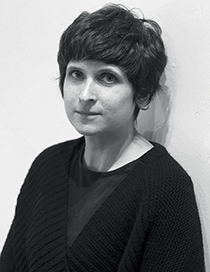
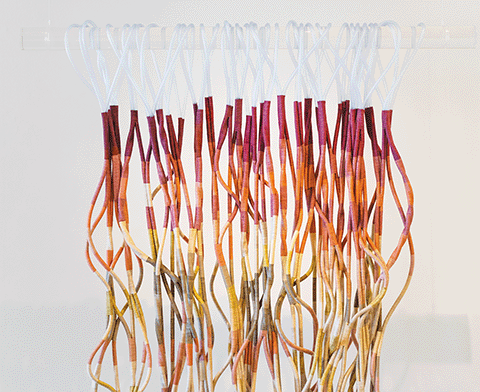
Weinberg tells us in her artist statement that she “create[s] weavings, sculptures, and drawings that explore the interconnected harms extraction inflicts on humans and the earth, from rising temperatures, species loss, and plastic proliferation to illness and displacement. I trace these connections through the systems and structures of weaving, vascular systems of people and trees, flows of watersheds, and streams of news and data. … Much of my work simultaneously references landscape and body.”
She continues, “I weave monofilament and cotton into silhouettes of tree species threatened by climate crisis, suspending the ghostly, semi-transparent forms upside-down to evoke lungs, arteries, and roots. I make sculptures referencing circulatory systems from the more-than-human world using expired, petrochemical-derived medical waste once associated with the circulatory systems of human bodies: Tourniquets become tree rings, and tubes become flowing water bodies. Together, these works retrace and reimagine relationships between corporeal and ecological bodies, between personal and communal loss, and between grief and possibility.”
Weinberg is currently based in Champaign-Urbana, Ill., but her art has traveled far and wide. She’s mounted solo shows in the Marian Gallery, Mount Mary University, Milwaukee; New York University Gallatin Galleries, New York, NY; University of Missouri Bingham Gallery, Columbia, Mo.; Denver Botanic Gardens, Denver, Colo.; and the California College of the Arts gallery, Oakland, Calif., among others.
A few of the group shows where she’s been invited to exhibit are Fowler-Kellogg Art Center, Chautauqua Institution, N.Y.; the Bemis Center, Omaha, Neb.; and form & concept gallery in Santa Fe, New Mexico. Weinberg’s art is in the collections of Berkeley Art Museum, Georgia Museum of Art, and Denver Botanic Gardens and is exhibited internationally, including at Griffith University Art Museum (Australia) and Zhejiang Art Museum (China).
She seems to be quite the “wandering Jew,” so we’re fortunate to have her art here in Minnesota until the end of this year. It’s a shame that the American Jewish World learned about Weinberg’s show too late to do an in-person interview at the opening back in January. She seems to be an interesting person as much as a talented artist.
Weinberg received her MFA from California College of the Arts and an interdisciplinary MA (textiles and social theory) and BA (peace studies) from New York University.
The schlep to Winona takes a little over two hours from the Twin Cities; but, if you combine your visit to the MMAM with a performance at Winona’s Beethoven Festival (which runs through July 19), you could make the most of the drive and spend the night discovering this under-appreciated gem on the Mississippi.
Or you could wait until mid-October and admire the fall colors during your drive, since the “Water | Craft” show is on display through Dec. 27, 2026.
***
For information about Minnesota Marine Art Museum, 800 Riverview Dr., Winona, Minnesota, go to: mmam.org.
(American Jewish World, July 2026)