


• About
  • Support AJW
  • Jewish Community Directory
  • Subscription Information
  • Contact Us
American Jewish World
No Result
View All Result
  • News
    • All
    • Africa
    • Asia
    • Australia & New Zealand
    • Europe
    • Israel/Mideast
    • Latin America
    • Minnesota
    • US & Canada
    Esther Capp’s spirit lives on at Esther’s Table

    Esther Capp’s spirit lives on at Esther’s Table

    Local social services agencies to merge

    Local social services agencies to merge

    It’s time to submit entries for the 2025 AJW Hanuka Cover Contest

    It’s time to submit entries for the 2025 AJW Hanuka Cover Contest

  • Arts
    • All
    • Blue Box
    • Books & Literature
    • Music
    • Televison & Film
    • Theater & Performing Arts
    • Visual Arts
    Director Ben McGovern reflects on ‘The Happiest Man on Earth’

    Director Ben McGovern reflects on ‘The Happiest Man on Earth’

    The Cookers return to Minneapolis

    The Cookers return to Minneapolis

    Local author remembers his father’s struggle against Nazism

    Local author remembers his father’s struggle against Nazism

  • Lifestyle
    • All
    • Fashion
    • Food
    • Health & Wellness
    • Home & Garden
    • Travel & Culture
    Esther Capp’s spirit lives on at Esther’s Table

    Esther Capp’s spirit lives on at Esther’s Table

    Jewish Cubans survive the island’s economic collapse

    Jewish Cubans survive the island’s economic collapse

    My time with the Greek Jewish community

    My time with the Greek Jewish community

  • Editorial
  • Opinion
  • AJW Digital Archives
  • News
    • All
    • Africa
    • Asia
    • Australia & New Zealand
    • Europe
    • Israel/Mideast
    • Latin America
    • Minnesota
    • US & Canada
    Esther Capp’s spirit lives on at Esther’s Table

    Esther Capp’s spirit lives on at Esther’s Table

    Local social services agencies to merge

    Local social services agencies to merge

    It’s time to submit entries for the 2025 AJW Hanuka Cover Contest

    It’s time to submit entries for the 2025 AJW Hanuka Cover Contest

  • Arts
    • All
    • Blue Box
    • Books & Literature
    • Music
    • Televison & Film
    • Theater & Performing Arts
    • Visual Arts
    Director Ben McGovern reflects on ‘The Happiest Man on Earth’

    Director Ben McGovern reflects on ‘The Happiest Man on Earth’

    The Cookers return to Minneapolis

    The Cookers return to Minneapolis

    Local author remembers his father’s struggle against Nazism

    Local author remembers his father’s struggle against Nazism

  • Lifestyle
    • All
    • Fashion
    • Food
    • Health & Wellness
    • Home & Garden
    • Travel & Culture
    Esther Capp’s spirit lives on at Esther’s Table

    Esther Capp’s spirit lives on at Esther’s Table

    Jewish Cubans survive the island’s economic collapse

    Jewish Cubans survive the island’s economic collapse

    My time with the Greek Jewish community

    My time with the Greek Jewish community

  • Editorial
  • Opinion
  • AJW Digital Archives
No Result
View All Result
Morning News
No Result
View All Result
Home Arts

European killing fields

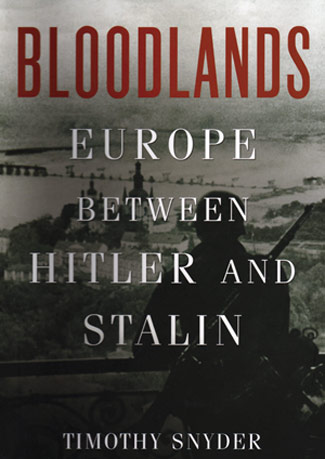
‘Bloodlands: Europe Between Hitler and Stalin’, by Timothy Snyder, Basic Books, 544 pages, $29.95

American Jewish World by American Jewish World
May 23, 2020
in Arts, Books & Literature
0
Share on FacebookShare on Twitter

Reviewed by NEAL GENDLER

Between 1933 and 1945, 14 million noncombatants died in the areas under Soviet, German, then Soviet control — not coincidentally the areas with Europe’s greatest concentration of Jews.

READ ALSO

Director Ben McGovern reflects on ‘The Happiest Man on Earth’

The Cookers return to Minneapolis

Where, how and — most important — why they died is explained in great but engaging detail by historian Timothy Snyder in Bloodlands, an important and unusual view of the slaughter of mostly innocents by 20th century Europe’s greatest grim reapers, Hitler and Stalin.

Although the majority of the deaths occurred because of Nazi invasion and rule, Stalin was no less sinister — directing massive killing according to social class, ethnic group, and because of consolidation of power and paranoia.

“The Germans generally killed people who were not Germans, whereas the Soviets usually killed people who were Soviet citizens,” Snyder says. “The Soviet system was most lethal when the Soviet Union was not at war,” while the Nazis killed only a few thousand people before the war.

Such insights abound as Snyder, a Yale history professor, takes a new look at Europe’s greatest calamity. A work much about Jews, its 417 pages of narrative and maps are easy reading until the final, rather analytical chapter of conclusions.
Snyder explains how he provides numbers of eyebrow-raising specificity, such as 681,692 recorded death sentences in Stalin’s Great Terror of 1937-38; or 21,892 Polish prisoners of war shot by Stalin’s NKVD in 1940; or 3,412 Jews killed by the Germans in Minsk on March 2, 1942. But who’s to argue with a work with 115 pages of notes, bibliography, footnotes and index?

His breakdown of Bloodlands slaughter also includes: 3.5 million Soviet citizens, mostly Ukrainian farmers starved in 1932-33, their grain confiscated for cities and for exports to fund industrialization; 5.4 million Jews; and 3.1 million Soviet POWs left to starve.

Fourteen million is but part of the reapers’ grim harvest, an estimate of “the number of people killed by purposeful policies of mass murder.” It excludes combat deaths — roughly 12 million on the eastern front — civilian deaths by forced labor, bombing or other acts of war, “those who died of exertion or disease or malnutrition in concentration camps or during deportations, evacuations, or flight from armies” or starved by wartime shortages.

Now-forgotten deportations and postwar dislocations dwarf the dislocation of 800,000 Palestinian Arabs: By 1947, 7.6 million ethnic Germans had left Poland and 3 million more were deported from Czechoslovakia. During the war, Stalin deported 900,000 Soviet ethnic Germans further east.

By war’s end, the NKVD, the Nazi SS and partisan groups had killed about 2 million in Belarus, where half the population was dead or moved. Poland and the Baltic states suffered partial or full annexation by the U.S.S.R., with scores of thousands killed by the NKVD, then by Germans eager to complete Stalin’s elimination of leaders and educated classes. Then the Soviets returned and the NKVD killed or dragged off even people who’d fought the Germans under non-Soviet leadership.

Worst off were Jews. They caught blame for the Great Terror; when it began, one-third of the high-ranking NKVD officers were Jews. By 1939, that was down to 4 percent, many of the Jewish NKVD having been purged after killing nearly 22,000 Jews. Germany then conquered Europe’s richest vein of Jews, Poland and Belarus, killing most.

Bloodlands continues to Stalin’s death in 1953, so it includes the 1947-48 purges and the later “Doctors’ Plot,” when Stalin said: “Every Jew is a nationalist and an agent of American intelligence,” which Snyder calls “a paranoid formulation even by his own standards.”

Snyder presents facts in great detail, dispassionately, without gruesome descriptions of torment or long witness accounts. But no effort at emotional inflammation is needed when the facts alone are so horrific.

***

Neal Gendler is a Minneapolis writer and editor.

(American Jewish World, 12.10.10)
Related Posts

Director Ben McGovern reflects on ‘The Happiest Man on Earth’
Theater & Performing Arts

Director Ben McGovern reflects on ‘The Happiest Man on Earth’

January 18, 2026
The Cookers return to Minneapolis
Music

The Cookers return to Minneapolis

January 16, 2026
Local author remembers his father’s struggle against Nazism
Books & Literature

Local author remembers his father’s struggle against Nazism

November 19, 2025
It’s time to submit entries for the 2025 AJW Hanuka Cover Contest
Visual Arts

It’s time to submit entries for the 2025 AJW Hanuka Cover Contest

November 17, 2025
‘Purple Rain’ hits the stage in Minneapolis
Theater & Performing Arts

‘Purple Rain’ hits the stage in Minneapolis

November 6, 2025
Kfar Aza October 7 exhibition makes U.S. debut in St. Louis Park
Minnesota

Kfar Aza October 7 exhibition makes U.S. debut in St. Louis Park

October 24, 2025
Next Post
Essence of Jewish jazz

Essence of Jewish jazz

Leave a Reply Cancel reply

Your email address will not be published. Required fields are marked *

RECENT ARTICLES

Director Ben McGovern reflects on ‘The Happiest Man on Earth’

Director Ben McGovern reflects on ‘The Happiest Man on Earth’

January 18, 2026
The Cookers return to Minneapolis

The Cookers return to Minneapolis

January 16, 2026
Why Jewish and Muslim communities in the U.S. need each other

Why Jewish and Muslim communities in the U.S. need each other

January 12, 2026
Editorial: Perhaps January will be better

Editorial: Perhaps January will be better

January 11, 2026
Cuban Jews endure the island nation’s precipitous decline

Cuban Jews endure the island nation’s precipitous decline

January 9, 2026

About

Since 1912 the AJW has served as an important news resource for the Jewish community. The Jewish World unites the main Jewish communities in St. Paul and Minneapolis, as well as those in Duluth, Rochester and smaller cities, and bridges the divides between the various Jewish religious streams.

Quick Links

  • About the AJW
  • Advertising Information
  • Submission Guidelines
  • Subscription Information
  • Jewish Community Directory

Contact Us

The American Jewish World
3249 Hennepin Ave., Suite 245
Minneapolis, MN 55408

Tel: 612.824.0030 / Fax: 612.823.0753
editor@ajwnews.com

  • Buy JNews
  • Landing Page
  • Documentation
  • Support Forum

© 2026 JNews - Premium WordPress news & magazine theme by Jegtheme.

No Result
View All Result
  • Home
  • News
  • Food
  • Health & Wellness
  • Lifestyle
  • Opinion
  • About the AJW
  • Jewish Community Directory
  • Support AJW
  • Subscription Information
  • Contact Us

© 2026 JNews - Premium WordPress news & magazine theme by Jegtheme.