






Jewish World readers might not be familiar with the ways of the Amish. Specifically, the practice of social shunning, also known as Meidung, as per an entry on the website Amish America (amishamerica.com).
The article notes that shunning is “a form of social avoidance, or changed public social behavior. It is an alteration of behavior towards an individual who has willfully violated rules of the church [Ordnung],” according to Amish America.
In Judaism, there is the practice of excommunication, also known as cherem. Likely the most famous case is that of philosopher Baruch (Benedict) Spinoza (1632-1677). “Spinoza’s excommunication by the rabbis of Amsterdam when he was in his mid-twenties was caused by his denial of angels, the immortality of the soul and God’s authorship of the Torah,” writes Rabbi Joseph Telushkin in Jewish Literacy (Morrow, 1991).
Several hundred years later, three rabbis, “snuffing candles and solemnly blowing a ram’s horn in a room at a Holiday Inn in Massachusetts,” excommunicated several hundred Jews “for alleged Marxist views on Israel and sex,” the Washington Post reported on Nov. 24, 1982. “The mainstream Jewish community reacted with laughter,” according to the Washington Post article:
“We don’t have excommunication anymore,” said Rabbi Seymour Siegel, professor of ethics and theology at the Jewish Theological Seminary in New York. “Those three [rabbis] have no status whatsoever.”
“I assume it would be rude to laugh,” said one of those excommunicated, Nobel laureate Salvador Luria, a biologist at the Massachusetts Institute of Technology. “I was about to open champagne to celebrate.”
The WaPo story added: “Wearing judicial robes before an audience of about a dozen supporters, the three snuffed the candles to symbolize the end of their targets’ spiritual lives, using the text of the 1757 excommunication of a Jewish heretical group called the Satanic Sabbatian Frankists in Brode, Poland.
“Any three rabbis may constitute a Jewish court, called a Bet Din, but its authority normally extends only over the congregations of the rabbis, and then only if the congregation members agree to it,” Siegel said. Excommunication, when done in the Middle Ages, “was always by a recognized ecclesiastical authority … but we don’t have central authorities now.”
I recall attending a lecture by MIT professor and author Noam Chomsky around this time. Chomsky told the Washington Post that he shared “the honor” of excommunication with the Dutch philosopher Spinoza. “I don’t think it will carry much weight in Israel except in very kooky circles,” Chomsky told the newspaper.
Following Chomsky’s talk at the University of Minnesota, there was a Q&A session, and I asked the professor about the widely reported excommu-nication and its effect on his “spiritual development.” He seemed to enjoy the nature of the question and noted that the practice of excommunication had a more profound impact in the old days when European Jews were ghettoized and forced to rely on communal resources for their survival.
This is a lengthy preface to my modest proposal that Jews aiding and abetting the benighted and cruel policies of Pres. Donald Trump should be shunned. The Jewish Trump officials should not be honored by synagogues and Jewish organizations.
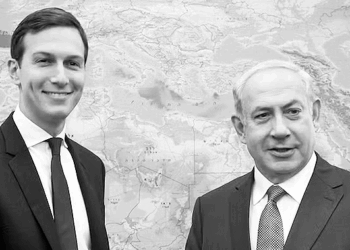
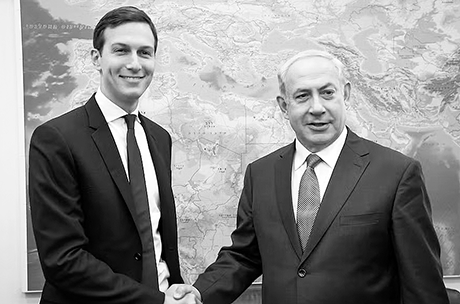
Jews should protest at any Jewish institution that deigns to honor Trump’s son-in-law Jared Kushner, the administration’s “peace envoy”; Commerce Secretary Howard Lutnick, a notable Trump sycophant; Lee Zeldin, administrator of the Environmental Protection Agency, which is busy dismantling regulations to actually protect the natural environment; Stephen Miller, White House deputy chief of staff for policy and the architect of the draconian immigration enforcement regime that included the deadly Operation Metro Surge in Minnesota; and Steve Witkoff, a Trump confidant who, with Kushner, has been mucking around in U.S. foreign policy without any prior experience.
Of course, there are many other Jews on the wrong side of history at this moment, including billionaires backing Trump and those attempting to enforce the president’s campaign against the free press in this country. In the latter category are Larry Ellison, of Oracle Corporation, and his son, David Ellison, CEO of Paramount Skydance, which is attempting to buy Warner Bros. Discovery in a deal reported at $111 billion.
“The Ellison family’s ties to President Trump — which included a dinner that David Ellison hosted in April ‘honoring the Trump White House’ — have made many Democrats and a sizable contingent in Hollywood wary of his growing power,” the New York Times reported on Sept. 22. “His empire will now span CNN and CBS News; HBO, MTV, BET, Comedy Central and TNT; the Paramount+ and HBO Max streaming services; and two of Hollywood’s oldest movie studios.”
Of particular concern is that the younger Ellison will transform news outlets under the purview of his company into Trump propaganda mouthpieces. We have already seen this trend of shaping the news in a Trump-friendly direction with the appointment of Bari Weiss as editor-in-chief of CBS News.
During the tenure of Weiss, 60 Minutes, the flagship CBS news show, has seen a wave of firings and departures of reporters and editors, including Scott Pelley, who accused Weiss of “murdering” the program, Sharyn Alfonsi, Cecilia Vega and Anderson Cooper.
The deal that brought Weiss to her high station at CBS News, in October 2025, included Paramount Skydance buying Weiss’ website, the Free Press, for a reported $150 million. It seems like an outlandish amount for an online outlet.
Many Jews hold a special animosity for Trumpite villain Stephen Miller, who sounds like a 20th-century totali-tarian leader and evokes comparisons to Nazi propaganda minister Joseph Goebbels, as far as his slavish dedication to the president. However, the accomplishments of Jared Kushner over the first and second Trump terms should not be overlooked.
Upon leaving his role as a Trump senior adviser in 2021, Kushner and his wife, Ivanka Trump, moved to Indian Creek, Florida, where they bought a mansion on a private island for $24 million. Kushner started a private equity firm and filled the outfit’s coffers with money from Middle East oil sheikhs, including a $2 billion investment from the Saudi crown prince, Mohamed bin Salman, who acted against the wishes of his financial advisers in handing over the large sum to a person with no experience in private equity.
There’s no law against making money, but Kushner’s machinations in the Middle East, soliciting investments while negotiating over the fate of Gaza and the U.S.-Israeli war on Iran, likely will be of interest to congressional investigators at some future date. Republicans got spun up about Hunter Biden’s involvement with a Ukrainian energy company; however, they have little to say about Kushner’s glaring conflicts of interest in his current role in the Trump 2.0 administration.
“Throughout the Trump era, Kushner has made a career of combining business and politics. He argues that being a businessman aids his diplomatic efforts, by allowing him to find inventive solutions to problems ordinarily handled by unimaginative bureaucrats. But, as he has traversed the globe for Trump, he has grown more entangled in the commercial affairs of countries where he works,” writes Dexter Filkins in The New Yorker. The article about Jared Kushner in the magazine’s Sept. 21 issue is titled “Dollar Diplomacy.”
Filkins continues about Kushner:
He represents a new kind of Washington figure, for whom public office serves as a means to extraordinary wealth. In the past two years, an array of people linked to the White House — including Witkoff’s sons, the cryptocurrency adviser David Sacks, and other members of the Trump family — have used their official positions to bring in billions of dollars for themselves. “I know all these guys,” a former American official who served in the Middle East told me. “They go into these meetings, and they are doing business right alongside their diplomacy. ‘O.K., enough about the ceasefire. We have this hotel we want to build.’ That’s the kind of foreign policy America has now.”
Kushner exhibits a spectacular degree of privilege in his current government post. He seems to be a person with no moral center and an overbearing arrogance. As I wrote in my May 2025 editorial, Kushner first came up with the idea of a real estate play upon the ruins of Gaza. When the Israeli Prime Minister visited the White House on Feb. 4, Trump announced to the assembled press: “The U.S. will take over the Gaza Strip, and we will do a job with it too.”
Trump added, “We’ll make sure that it’s done world-class. It’ll be wonderful for the people — Palestinians, Palestinians mostly, we’re talking about.”
Kushner had made a similar pitch the previous year. At a Feb. 15, 2024, panel hosted by the Middle East Initiative, a program of Harvard’s Kennedy School of Government, Kushner said, “Gaza’s waterfront property could be very valuable … if people would focus on building up livelihoods.”
He added, “It’s a little bit of an unfortunate situation there, but from Israel’s perspective I would do my best to move the people out and then clean it up.”
Meanwhile, Kushner continues to seek investments for his private equity firm, Affinity Partners. The Iran war has settled into a quagmire, Iran has blocked shipping through the Strait of Hormuz and Trump has threatened the nation with “annihilation.” Or maybe a deal can still be made.
Dexter Filkins, in his article for The New Yorker, notes that “as Kushner engaged in talks with Iran, he was also discreetly raising another five billion dollars for Affinity in the Middle East. After the attacks on Tehran began, suspicions arose that the two endeavors were linked. ‘My sense is that he thinks he was killing two birds with one stone — he was helping the Arabs defeat the Iranians, and he wanted to be paid for it,’ an American with deep ties to Middle Eastern leaders told me.”
The mixing of U.S. foreign policy and private gain is also the focus of Anne Applebaum’s cover story, “Empire of Grift,” in The Atlantic’s October 2026 issue. “American power is no longer deployed solely by trained diplomats and reliable officials, working through state channels,” writes Applebaum. “Informal envoys, private companies, online grifters, and hardened ideologues both inside and outside the government matter more. Unlike their predecessors, these people do not talk about spreading democracy, and don’t want to build long-term relationships. They don’t care about America’s reputation. They are deploying the tools of American diplomacy and government for their own purposes, to promote their own business interests or their own ideological goals, because, suddenly, they can.”
Applebaum’s initial focus is the Trump administration’s meddling in Brazil, but it widens out to assess varied foreign policy misadventures from Canada to Greenland.
Applebaum mentions that in January of this year, “Steve Witkoff, the real-estate dealer turned U.S. special envoy, told a roomful of European presidents and prime ministers gathered in Paris to discuss support for Ukraine that he was already negotiating energy and mineral deals for American companies with Russia, to be implemented after the war. This surprised many of the meeting’s attendees, whose main concern was bringing peace to Ukraine. (A White House spokesperson denied that Witkoff made this statement.) Witkoff also specifically mentioned the role that the U.S. investment company BlackRock could play in the reconstruction of Ukraine, an unusual comment for a peace negotiator. But maybe not a surprising one: BlackRock CEO Larry Fink has sat next to Jared Kushner while he negotiated with the Ukrainians, according to The New York Times.”
And Applebaum also looks at the previously mentioned tragedy of Gaza — and its potential as a moneymaker for the constellation of grifters around Donald Trump:
Trump’s Board of Peace, the quasi-governmental organization whose rules read like those of an exclusive golf club — Trump, as chair, has the right to name his successor, select the board, and determine the mission — presents the same dilemma: Is this organization, much of whose funding is not transparent and comes from member states in the Persian Gulf, designed to make peace, or make money? Does it represent the views of America, or of its funders? In the name of rebuilding Gaza, the board, according to The Guardian, has sought to grant itself the power to seize Palestinian land and buildings, perhaps paving the way for American companies to enact the “New Gaza” plan, a redevelopment project proposed by Kushner, a private citizen (and Trump’s son-in-law) who is of course a board member, as well as Witkoff’s negotiating partner on Russia.
Historians will be writing volumes about the incompetence and corruption of Trump’s misrule for years to come. And remediating the damage done to this country by Trump and his GOP enablers will be a generational project. Getting back to my Jewish — and Amish — angle at the top, we should shun the Jewish Trump sycophants that have put us in this fix. They must be held accountable for the repression we saw on the streets of Minneapolis earlier this year. If justice is not served, we cannot expect any improvement in society.
Mordecai Specktor / editor [at] ajwnews [dot] come
(American Jewish World, October 2026)