





Reviewed by NEAL GENDLER
You think you have tsuris?
Rabbi Adinah Feld has just returned from three weeks in Israel to find that a hurricane tore off a corner of her New Jersey synagogue’s roof, letting in torrents of water.
That corner is right above her office, leaving piles of sodden paper and ruining her cherished mother-of-pearl, Star of David-inlay table she’d bought years ago outside the Alhambra.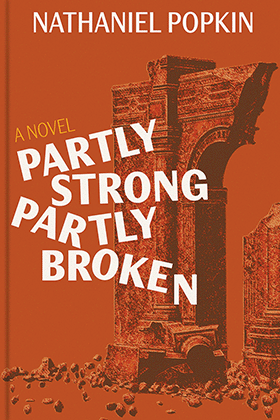
Louis, Temple Beth Israel’s longtime but decreasingly capable property manager, is feuding with Debra, Adinah’s hyper-capable administrator, over dealing with the insurance people.
The congregation president is enthusiastic about Adinah’s dream for “an immersive center for teaching Hebrew to the children and adults” and for finding the funds. But he wants the project managed by a well-qualified congregant who Adinah considers domineering, sarcastic and rude.
Worse, Fami, a college student working at the synagogue for the summer, is fighting for her life after being attacked after leaving a Labor Day party. She and her mother, Syrian refugees, had been taken under the congregation’s wing. When Fami was 14, Adinah became her mentor.
Such tsuris (trouble) you wouldn’t wish on an unfriendly mother-in-law. And Rosh Hashana is just 10 days away. Welcome home.
Comic as most of this seems, novelist Nathaniel Popkin’s Partly Strong, Partly Broken is an engaging, entertaining yet subtly serious look at the differences among largely secular American Jews and the difficulties rabbis face dealing with them while trying to hold congregations together.
Adinah, 45, has been at Reform’s Temple Beth Israel for eight years and is part of the city’s Multifaith Coalition, which welcomes refugees, sustains food banks and buys LGBTQ+ books for the local library.
“The heart of the coalition, for the rabbi at least, was Imam Abdul,” the one to steer the group toward concrete action.
The temple and Abdul’s Masjid Al-Aksa mosque have grown close, and so have their two leaders, who attend each other’s congregational events. Abdul seems to be Adinah’s closest friend.
“They pledged to each other unconditional support,” Popkin writes, “reasoning that if a California-born lesbian rabbi and a Detroit-born Palestinian American educated in Cairo could work toward common objectives, then anyone could.”
After the coalition meeting, Adinah recalls a story told to her during her last week in Israel by Sana, her long-ago lover, about a man close to death who miraculously revives after his family and relatives hold a vigil, reciting his name and trying to direct their energy toward him.
Why not a vigil for Fami? Imam Abdul buys in, suggesting it be held at the mosque. Soon, Adinah pitches the idea to her top Sunday school teachers, high school seniors, for whom she’s brought Israeli gifts.
There’s an anti-Netanyahu flag for Theo, interested in justice, and hamsa earrings for Celia, whip smart with a mouth to match. They’re close friends; Theo would like to be more. They agree to organize the vigil and invite friends. It is a huge success.
But some congregants disapprove of Adinah’s closeness to Abdul and her efforts at temple-mosque relations. And some fearfully disapprove of her permission to let Theo build the temple’s sukka proudly out front, visible to all who pass by.
At a board meeting, Debra reports issuing 1,500 High Holiday tickets. The meeting turns to the Hebrew learning center, igniting an angry debate about the need to learn Hebrew to be a Jew.
Two more incidents, one of them a whisky-sampling evening with a lecture from a speaker who claims trauma can be passed down through generations — Jewish and Arab — shake Adinah’s popularity and grip on her congregation. With Rosh Hashana looming, Adinah ponders it as high-performance time for a rabbi.
“Those who came every week had no need for the performance,” Popkin writes, “and while some were heartened to see so many people and welcomed them like long-lost friends, quite a few others experienced the High Holidays as an invasion of the false and the feckless.”
The latter was her target audience.
The deeper you get into Partly, the richer it becomes, including phrases and prayers in Hebrew type (translated) and Adinah’s explanations of Jewish faith, culture and ethics. There’s a book club guide for discussion. Those with scant knowledge of Jewish fundamentals can get an education that’s entertaining and affectionate.
All of us can just enjoy.
***
Neal Gendler is a Minneapolis writer and editor.
(American Jewish World, August 2026)