




By DORIS RUBENSTEIN
Minnesota was the focus of global press attention earlier this year due to the activities of Operation Metro Surge, the immigration enforcement action by the U.S. Department of Homeland Security. Now, our community is again the focus of another sad but inspirational event titled Violins of Hope.
Sad because the prior owners of these instruments were all killed in the Holocaust; inspirational because their musical voices have been revived and can be heard around the world and will be part of our Minnesota cultural scene for several weeks.
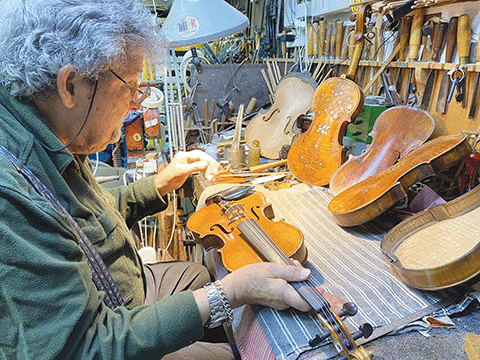
Israeli violinmakers, the late Amnon Weinstein and his son, Avshalom “Avshi” Weinstein, “spent the last 20 years collecting and repairing 70 Holocaust-era violins and other stringed instruments from around the world, some with the Star of David on the back and others with names and dates inscribed within the instrument,” according to event marketing.
The Weinsteins “lovingly located and restored the violins to reclaim their lost heritage, give voice to the victims, and reinforce essential messages of hope, harmony and humanity. … Through performances, exhibitions, and educational series, the instruments have impacted and inspired hundreds of thousands of people of all ages. Violins of Hope has traveled across the globe and has been featured in Rome, Tel Aviv, London, Washington D.C., Chicago,” among others, and now, here in Minnesota.
The Minnesota JCC will officially launched Violins of Hope, an eight-week residency, with events — many of which are free — spanning May and June. The opening event took place on May 3 at the Minnesota JCC Capp Center in St. Paul, “Community and Continuity: Voices of Hope in Dark Times,” and featured the Minnesota JCC Symphony Orchestra performing on some of the historic instruments that survived the Shoah.
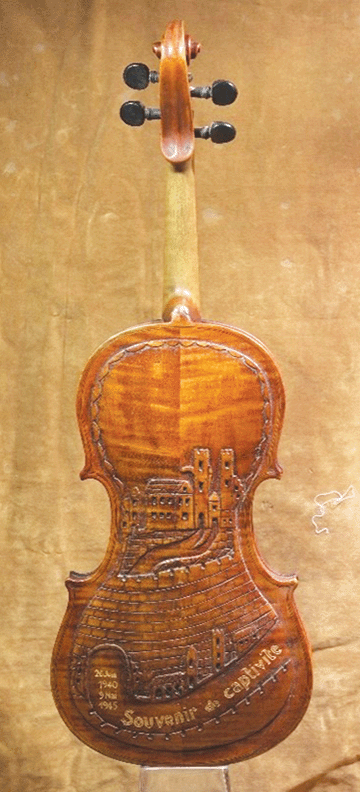
The evening weaved together music and storytelling to honor the legacy of the original owners, featuring a rare appearance by Tel Aviv luthier Avshi Weinstein, who has dedicated his life to preserving this collection. Of particular note, on Tuesday, May 5, Temple Israel’s annual fundraiser, “Voices: Ideas for Our Time,” presented an evening with violinist Itzhak Perlman in collaboration with Violins of Hope. Perlman, one of the most celebrated violinists of our time, is a 16-time Grammy Award winner and has performed with virtually every major orchestra around the world.
Twin Cities native Marc Levine is coordinating the daunting task of arranging venues and musicians who will be performing with JCC Symphony at the Capp Center on May 3, at Hamline University’s Sundin Hall on May 31, and June 28 at the JCC’s Sabes Center in St. Louis Park.
Levine will perform Ernest Bloch’s “Niggun,” part of the Baal Shem Suite, on the Shlomo Violin, the instrument used by acclaimed violinist Shlomo Mintz when he played at the gates of Auschwitz.
Yes, each performing violin has a name; nearly all of the Violins of Hope have names.
The Moshe Amiran Violin surfaced far from Europe, in Santiago, Chile, where a man rebuilding his life after the Holocaust kept it close as his one constant companion. He shared that the violin had belonged to his grandfather, who entrusted it to him in childhood with a promise to never let it go. Deported in 1942, he was sent first to a labor camp and later to Auschwitz-Birkenau. When he eventually crossed continents and oceans to rebuild his life in Chile, the instrument traveled with him. In the 1970s, the violin passed into the care of Moshe Amiran, who carried it back to Israel.
Another violin story concerns Manfred Katz, who lived in Germany as a Romanian citizen prior to World War II. His father placed a violin in his young hands as a gift meant to accompany him throughout his life. After he married Betty, they were forced to move to Romania but had to abandon nearly everything they owned; then they were interned in a ghetto where daily life was stripped to the bare minimum and hope became fragile. Through displacement, fear and the uncertainty of survival, the violin remained the one object the Katz family managed to keep. Today, the Manfred Katz Violin survives as the single tangible thread connecting their past in Germany to the generations who followed.
And the Benedict Wagner Violin was made in 1774, placing it among the oldest instruments in the collection. More than two centuries after it was built, the instrument found its way into the hands of Moshe Weinstein, the first violin maker in the Weinstein family. Weinstein acquired the violin from a member of the Palestine Orchestra who no longer wished to keep it. By entering Weinstein’s care, the violin became directly connected to the beginning of a family line that would go on to restore, preserve and share instruments of Jewish heritage.
Choosing which musician will play which violin is up to the artistic director of each of the many venues in the project. According to Levine, there tends to be an artistic and emotional connection; in addition, it also happens that more than one musician may choose the same instrument, although there are some 60 violins plus a viola or cello in the Violins of Hope collection.
Twenty instruments of the 60 in the program have been deemed strong enough to be played; the others will be in exhibitions at museums and other venues, including Orchestra Hall, St. Mark’s Episcopal Cathedral and the Museum of Russian Art in Minneapolis.
And if you thought that the Minnesota Sinfonia had breathed its last in 2025, you were wrong. The JCC invited the Sinfonia to be a part of the Violins of Hope residency. Director Jay Fishman will be conducting free concerts across the Twin Cities metro area.
“I am so pleased to be involved with Violins of Hope,” Fishman said. “This is a very special project and a wonderful and a fitting way for me to close out my career of conducting in the Twin Cities for the past 48 years.”
The Sinfonia concert program will include Sergei Prokofiev’s Overture on Hebrew Themes, Max Bruch’s Kol Nidrei, Hassidic Suite by Joachim Stutschewsky and Ernest Bloch’s Concerto Grosso No. 1. Cellist Amit Peled will be the featured soloist, playing a Violins of Hope cello.
Also, Janet Horvath, former associate principal cellist for the Minnesota Orchestra, will perform in a Violins of Hope concert on May 9, which will be hosted by B’nai Israel Synagogue in Rochester. Horvath will join musicians from the Rochester Symphony performing on instruments from Violins of Hope. Horvath also will provide commentary connecting the music to the lives and histories each instrument carries.
Both of Horvath’s parents were professional musicians and Holocaust survivors. Her father played 200 morale building concerts in the displaced persons camps of Bavaria after World War II, from 1946-48, two of which featured maestro Leonard Bernstein.
Horvath has been an active anti-racism spokesperson and writer. She authored the award-winning book The Cello Still Sings, which tells her family story.
The Violins of Hope residency “is a meaningful opportunity to partner with more than 50 organizations to share a narrative of resilience across our region,” said Alex Fisher, chief programming officer at the Minnesota JCC. “In a time of significant upheaval, these violins serve as a bridge, allowing us to come together and find strength in our shared history and our connections to one another.”
***
For the complete calendar of events and ticket information, visit the Minnesota JCC’s website.
(American Jewish World, May 2026)