






Reviewed by NEAL GENDLER
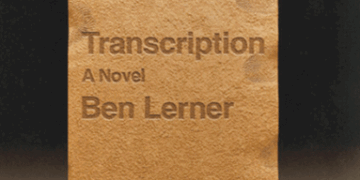
A confession: Much of the first half of Ben Lerner’s novel Transcription made little sense to me until I read the third of its three parts and then went back to skim through the first.
It is an insightful and clever story of a father and son, with much of the life of the son’s college friend — who narrates the first and second parts — included.
The difficulty is that the father-son part is the third.
The book opens with the unnamed narrator, 45, returning to Providence, R.I., to interview Thomas, one of his former professors, now 90, for whom he’d been an undergrad research assistant.
Thomas — no last name — was an expert in many subjects but “among the world’s most renowned thinkers about art and technology.”
The narrator plans to record the interview on his iPhone. But almost unimaginably for someone skilled enough to be put up by a magazine in a $200-a-night hotel, he has brought no backup — no second cellular phone or tape recorder.
Getting ready to see Thomas, he accidentally brushes his phone into a watery sink. Bad enough, but when he sees blurry images on the screen, he plugs the phone into its charger, frying it. He also doesn’t wear a wristwatch, so without his phone, he doesn’t know what time it is — or will be for daughter Eva when he keeps his promise to call her after the interview.
He walks to meet Thomas, and we learn much of his life story and get a description of what’s along his path, which includes places he met with Mia, who eventually marries him.
He thinks he can stall, using the evening to get reacquainted and returning for the interview in the morning, new phone in hand. But Thomas insists on starting the interview, asking the narrator if he’s recording. The narrator says yes and takes the dead phone out of his pocket and puts it down.
This will have deserved consequences in the book’s second section.
The narrator begins: “You were saying that your earliest memories involve the radio?”
Thomas, born in Augsburg, Germany, in 1934, replies: “The first experience of voice is disembodied, yes? Voices heard in utero: your mother’s voice, your father’s. The postman’s. Your sister singing Ein Männlein steht im Walde. The uncle. They talk to you, ‘Hello in there,’ but you also overhear. When my uncle visits my father, for instance, my mother, carrying me, brings them their coffee.” And Hitler on the radio.
Not quite the stuff for a 5,000-word magazine article, and the rest of the answers are little better, including a reminiscence of the narrator accompanying Thomas on a trip to Switzerland, where the narrator earlier said he’d never been.
Thomas’ answers start with one topic and drift, incomplete, into others. You can’t help wondering if he is brilliant or becoming senile. Perhaps both.
Part two takes place in Madrid — with more descriptions of place — where the narrator has given a successful speech, apparently based on the interview and his relationship with Thomas. He’s at a post-speech lunch with several people given by a longtime acquaintance, Rosa. She’s a curator at a museum called Reina Sofa and was devoted to Thomas, who had a long history with the museum and has died.
It doesn’t end well.
The third story begins without warning that it’s narrated by a different person, making the reader wonder why there’s a different wife and daughter. It’s Max, Thomas’ son and friend of the first narrator. His young daughter is driving her lawyer parents batty over her refusal to eat more than a bite or two, falling far behind normal growth.
This section is in quotation marks, which we figure out is Max talking to the first narrator, who occasionally interrupts. There’s no identifying attribution, so close attention is needed.
I’m likely giving away Lerner’s intention by not making you, like me, figure out who’s talking there and supplying answers to mysteries in the first section. When you finish reading Transcription, you’ll realize that it’s a serious tale of troubled relationships plus a dig at a writer’s ethics. Lerner already is lauded for his work and no doubt also will be for this novel’s story and unusual way of telling it.
Lerner may enjoy making people think hard to decode his message, but to a former reporter who toiled 40 years producing easily understood writing, that’s pretentious and needlessly frustrating.
***
Neal Gendler is a Minneapolis writer and editor.
(American Jewish World, September 2026)