





By MORDECAI SPECKTOR
On Aug. 14, Ben Sidran, the renowned jazz pianist, composer, chronicler of American music and raconteur, will turn 83. He’s been playing the Twin Cities for more than five decades and will return to the Dakota for a show on Aug. 17.
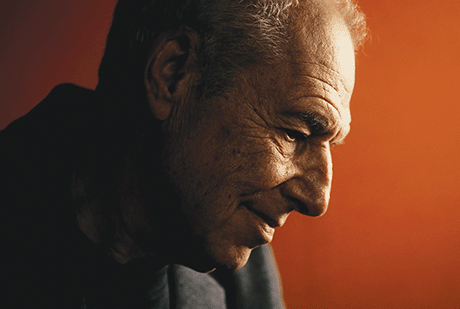
During a recent telephone interview from his home in Madison, Wisc., Sidran reflected on his musical career, a new book about Georgie Fame and the state of the American Revolution 250 years on.
Ben Sidran at the Dakota on Aug. 17
“I always love playing the Dakota,” Sidran commented about the upcoming gig. “It’s a great room, it really is. And being there with Billy and Ricky, it’s old home week for me, just being with those guys and Leo, of course, … I always look forward to it.”
For those unfamiliar with the Sidransphere, Billy Peterson, of Minneapolis, will be on bass and his brother, Ricky Peterson, will navigate the Hammond B3 organ. Leo Sidran, Ben’s son, will be on the trap set.
Regarding the upcoming birthday, I mentioned enjoying shows by the first-generation blues artists that performed around the University of Minnesota in the late 1960s: Mississippi Fred McDowell, Mance Lipscomb, Arthur Crudup, Jesse Fuller, et al. And I ventured that Sidran is likely as old as those bluesmen were back then.
“Older,” Sidran replied. “It’s really wild and kind of strange to realize that.”
The native of Racine, Wisc., said that he doesn’t feel old, apart from “some infrastructure issues that I didn’t have.”
He added, “My perception of where I am and what my job is, is pretty much the same. That must have been true for all those guys, too,” he commented about the legendary bluesmen of yesteryear. “You get on that path and that’s it, you ride it out.”
Sidran allowed that he never saw himself as one of “the old jazz guys,” his heroes.
“I just hope that I live as long as Irv Williams, that’s my goal,” Sidran concluded, in reference to the local legend of the saxophone who moved to the big bandstand in the sky in 2019 at the age of 100.
I recall seeing Williams sitting in with Sidran and company some years ago at the Dakota. The show followed the publication of Sidran’s book There Was a Fire: Jews, Music and the American Dream, which was a finalist for a 2012 National Jewish Book Award. The volume is perhaps the definitive work on the prodigious contributions of Jews to American popular music — without the Jewish tunesmiths, there would be a much thinner Great American Songbook.
And speaking of books, Sidran just published Cool Cat Blues: The Life and Times of Georgie Fame (Equinox Publishing).
Fame (né Clive Powell) came from humble origins in England, and his band, Georgie Fame and The Blue Flames, helped popularize American Black music in swinging 1960s London.
“We’re the same age, and we both grew up on a similar diet of music,” Sidran explained. “He never was that famous in the United States because unlike the Beatles and the Stones and the other British Invasion bands, he played keyboards,” when guitar bands were the sensation.
“I met Georgie in the ’80s, when I was just starting GoJazz Records, my record label; so, for about 30 years, we spent a lot of time together, all over the world. … And I got to hear his story, which I found absolutely one of a kind,” Sidran remarked.
“How he went in a few short years from dropping out of high school and working in a cotton mill to dining with British aristocracy and Diana Ross and being No. 1 on the pop charts. It’s an extraordinary story of the British cultural explosion.”
Fame’s hits back then included “Yeh, Yeh,” “Get Away” and “The Ballad of Bonnie and Clyde.”
Sidran agreed that the kids don’t know from Georgie Fame.
And as he’s done over many years, Sidran played dates in Europe this summer, following shows in New York City. “We always go to London and Paris and Madrid and Barcelona — some years we go beyond that,” Sidran recounted.
In a recent episode of Leo Sidran’s “The Third Story podcast,” Leo talked with his father while they were on vacation with their families on the Greek island of Paros. The talk turned to “democracy” — a word from ancient Greece — and its endangered state under the current Trump 2.0 regime.
Sidran observed that, from the vantage of Europe, “you can see your life in America more clearly.” And he mentioned that Europeans have a different view of the United States.
“Nobody that I [talked to] anywhere in Europe could understand how America and Americans could wind up in this situation that we’re in now — it’s just incomprehensible [to them], as it is to the majority of Americans.”
That accords with my conversations with friends and in-laws over two weeks in July in Denmark and Sweden.
Sidran’s most recent album, Are We There Yet (Live at the Sunside), released last year on the Nardis label, was recorded in Paris in 2024.
As our conversation wound down, I wondered if Sidran, who was the host of National Public Radio’s jazz series “Jazz Alive,” which received a Peabody Award, ever interviewed Sonny Rollins, the esteemed jazz saxophonist who died on May 25.
“I interviewed him a few times for different reasons over the years,” he replied. “A very sweet man, a gentleman, humble, the last redwood in the forest — the forest being the picture that was taken on the steps in Harlem.”
Sidran was referring to the famous group portrait of jazz greats assembled in front of a Harlem residence, in 1958. Apparently, Rollins was the last living jazz artist in the photo by Art Kane (né Arthur Kanofsky) titled “A Great Day in Harlem.”
***
Existential jazz poet Ben Sidran and his group will perform 7 p.m. Monday, Aug. 17, at the Dakota, 1010 Nicollet Mall, in downtown Minneapolis. For tickets, go to dakotacooks.com or call 612-332-5299.
Upcoming shows at the Dakota include St. Louis Park native Peter Himmelman on Aug. 20; Broadway star Shoshana Bean, Sept. 21; and Don Was and The Pan-Detroit Ensemble, Oct. 4.
(American Jewish World, August 2026)