





• About
  • Support AJW
  • Jewish Community Directory
  • Subscription Information
  • Contact Us
American Jewish World
No Result
View All Result
  • News
    • All
    • Africa
    • Asia
    • Australia & New Zealand
    • Europe
    • Israel/Mideast
    • Latin America
    • Minnesota
    • US & Canada
    Esther Capp’s spirit lives on at Esther’s Table

    Esther Capp’s spirit lives on at Esther’s Table

    Local social services agencies to merge

    Local social services agencies to merge

    It’s time to submit entries for the 2025 AJW Hanuka Cover Contest

    It’s time to submit entries for the 2025 AJW Hanuka Cover Contest

  • Arts
    • All
    • Blue Box
    • Books & Literature
    • Music
    • Televison & Film
    • Theater & Performing Arts
    • Visual Arts
    ‘Little Wars’ looks to the past to explain our present

    ‘Little Wars’ looks to the past to explain our present

    These Jews were not toying around

    These Jews were not toying around

    A fighter in the Polish forest

    A fighter in the Polish forest

  • Lifestyle
    • All
    • Fashion
    • Food
    • Health & Wellness
    • Home & Garden
    • Travel & Culture
    Editorial: Arizona vacation during wartime

    Editorial: Arizona vacation during wartime

    Esther Capp’s spirit lives on at Esther’s Table

    Esther Capp’s spirit lives on at Esther’s Table

    Jewish Cubans survive the island’s economic collapse

    Jewish Cubans survive the island’s economic collapse

  • Editorial
  • Opinion
  • AJW Digital Archives
  • News
    • All
    • Africa
    • Asia
    • Australia & New Zealand
    • Europe
    • Israel/Mideast
    • Latin America
    • Minnesota
    • US & Canada
    Esther Capp’s spirit lives on at Esther’s Table

    Esther Capp’s spirit lives on at Esther’s Table

    Local social services agencies to merge

    Local social services agencies to merge

    It’s time to submit entries for the 2025 AJW Hanuka Cover Contest

    It’s time to submit entries for the 2025 AJW Hanuka Cover Contest

  • Arts
    • All
    • Blue Box
    • Books & Literature
    • Music
    • Televison & Film
    • Theater & Performing Arts
    • Visual Arts
    ‘Little Wars’ looks to the past to explain our present

    ‘Little Wars’ looks to the past to explain our present

    These Jews were not toying around

    These Jews were not toying around

    A fighter in the Polish forest

    A fighter in the Polish forest

  • Lifestyle
    • All
    • Fashion
    • Food
    • Health & Wellness
    • Home & Garden
    • Travel & Culture
    Editorial: Arizona vacation during wartime

    Editorial: Arizona vacation during wartime

    Esther Capp’s spirit lives on at Esther’s Table

    Esther Capp’s spirit lives on at Esther’s Table

    Jewish Cubans survive the island’s economic collapse

    Jewish Cubans survive the island’s economic collapse

  • Editorial
  • Opinion
  • AJW Digital Archives
No Result
View All Result
Morning News
No Result
View All Result
Home Arts

Indicting the Nazi SS — in 1933

American Jewish World by American Jewish World
May 23, 2020
in Arts, Books & Literature
0
Share on FacebookShare on Twitter

Hitler’s First Victims: The Quest for Justice, by Timothy Ryback, Knopf, $26.95

Reviewed by NEAL GENDLER
Stranger than fiction: In spring 1933, a Bavarian prosecutor obtained indictments against SS members for the murders of four prisoners at Dachau.
Timothy Ryback’s Hitler’s First Victims is a short, fascinating, disturbing story of an honest man’s courage and of the treatment of Nazi Germany’s first concentration camp victims — political prisoners shot or beaten to death for no apparent reason but the sadistic enjoyment of their tormentors.
The hero is Josef Hartinger, then 39, deputy prosecutor for a large area near Munich in which the Nazis created their first concentration camp in an abandoned World War I ammunition plant.
Hartinger’s notes and files are “some of the earliest forensic evidence of the systematic execution of Jews by the Nazis,” says Ryback, who also authored Hitler’s Private Library: The Books That Shaped His Life and The Last Survivor: Legacies of Dachau.
Ryback learned of these early Dachau murders during a New Yorker assignment in the 1990s. Two Germans previously had written of them, and Ryback thought there was little to add until he discovered Hartinger’s “unpublished, and seemingly forgotten, account.”
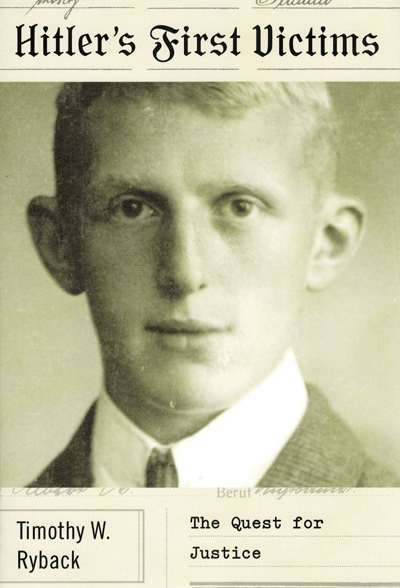
Hitler's-First-Victims
Hartinger saw the Nazi regime’s growing consolidation of power, but after four chancellors in 10 months, he thought Hitler also wouldn’t last, Ryback says. Hartinger, part of the “first generation of state prosecutors trained in the processes and values of a democratic public,” had pursued Communists and Nazis with equal vigor.
The law required police to report any case in which “a person has died from causes other than natural ones,” and the prosecutor to investigate “until he has determined whether an indictment is to be issued.”
Suspecting SS accounts immediately, Hartinger investigated the camp deaths as homicides, getting proof from autopsies by an equally courageous medical examiner, Dr. Moritz Flamm.
Most of the victims were Jews, including the first four, shot at close range — allegedly while attempting escape. One still alive was taken to a hospital where he told the real story before dying. As weeks went by, increasing numbers of men taken into “protective custody” for real or alleged political opposition were driven to Dachau by state police, one of whom told a prisoner: “As long as we are on guard here, nothing will happen to you, but if we leave, you will be in trouble.”
Police originally ran Dachau, but the SS soon kicked them out and the abuse began. Prisoners were beaten day after day and shot at the whim of the commandant and SS men — especially one Hans Steinbrenner, head of the camp’s whipping staff. Deaths were recorded falsely as suicides, escape attempts and attacks on guards.
Hartinger’s first prosecution requests were rebuffed, but as the killings continued, he decided to take four cases “with incontrovertible evidence” for indictments “with the intent of demonstrating a pattern of deaths that suggested the intentional serial killing of detainees with possible chain-of-command involvement.”
Hartinger indicted “unknown perpetrators” (he had three in mind) for murder and the camp’s SS physician, office administrator and commandant for aiding and abetting the killings.
The indictments rose all the way to Hitler, who quashed them. But 12 years later, they were introduced at the Nuremburg trials to help criminalize the SS.
Ryback is an excellent writer, and the pages fly by, though not without upsetting details of the sadistic killings. The cover photo is of Wilhelm “Willy” Aron, a 25-year-old Jewish junior attorney from Bamberg, who was beaten to death by Steinberg and crew.
Hitler’s First Victims reminds us of things now little known. One is that President Hindenburg opposed Hitler’s anti-Jewish policies and more than once admonished him, even getting Jewish veterans restored to their civil-service positions. Another is the extent of the turmoil in Germany after its 1918 defeat. For a time, Bavarian Communists proclaimed a state, setting off a civil war with atrocities that Hartinger was determined to prevent recurring.
He couldn’t, but unlike many Germans, who remained passive or frightened, he tried. Ryback’s book is a decades-overdue and well-deserved recognition.

***

READ ALSO

‘Little Wars’ looks to the past to explain our present

These Jews were not toying around

Neal Gendler is a Minneapolis writer and editor.
(American Jewish World, 10.24.14)

Related Posts

‘Little Wars’ looks to the past to explain our present
Theater & Performing Arts

‘Little Wars’ looks to the past to explain our present

April 17, 2026
These Jews were not toying around
Books & Literature

These Jews were not toying around

April 10, 2026
A fighter in the Polish forest
Books & Literature

A fighter in the Polish forest

March 22, 2026
Artworks by Rachel Leah Cohn create a mood of tranquility
Visual Arts

Artworks by Rachel Leah Cohn create a mood of tranquility

March 22, 2026
Director Ben McGovern reflects on ‘The Happiest Man on Earth’
Theater & Performing Arts

Director Ben McGovern reflects on ‘The Happiest Man on Earth’

January 18, 2026
The Cookers return to Minneapolis
Music

The Cookers return to Minneapolis

January 16, 2026
Next Post

Spinoza story spins a great tale at MJTC

Leave a Reply Cancel reply

Your email address will not be published. Required fields are marked *

RECENT ARTICLES

‘Little Wars’ looks to the past to explain our present

‘Little Wars’ looks to the past to explain our present

April 17, 2026
These Jews were not toying around

These Jews were not toying around

April 10, 2026
Editorial: Arizona vacation during wartime

Editorial: Arizona vacation during wartime

April 17, 2026
A fighter in the Polish forest

A fighter in the Polish forest

March 22, 2026
Artworks by Rachel Leah Cohn create a mood of tranquility

Artworks by Rachel Leah Cohn create a mood of tranquility

March 22, 2026

About

Since 1912 the AJW has served as an important news resource for the Jewish community. The Jewish World unites the main Jewish communities in St. Paul and Minneapolis, as well as those in Duluth, Rochester and smaller cities, and bridges the divides between the various Jewish religious streams.

Quick Links

  • About the AJW
  • Advertising Information
  • Submission Guidelines
  • Subscription Information
  • Jewish Community Directory

Contact Us

The American Jewish World
3249 Hennepin Ave., Suite 245
Minneapolis, MN 55408

Tel: 612.824.0030 / Fax: 612.823.0753
editor@ajwnews.com

  • Buy JNews
  • Landing Page
  • Documentation
  • Support Forum

© 2026 JNews - Premium WordPress news & magazine theme by Jegtheme.

No Result
View All Result
  • Home
  • News
  • Food
  • Health & Wellness
  • Lifestyle
  • Opinion
  • About the AJW
  • Jewish Community Directory
  • Support AJW
  • Subscription Information
  • Contact Us

© 2026 JNews - Premium WordPress news & magazine theme by Jegtheme.