





Reviewed by NEAL GENDLER
Matt Goldman knows how to grab your attention and hold it.
“Rose Kaner rested the rifle’s butt on the floor and gripped the gun barrel, still warm from spinning half a dozen .22 longs out its muzzle. All six rounds found flesh …
“Rose Kaner did not regret what she’d had to do.”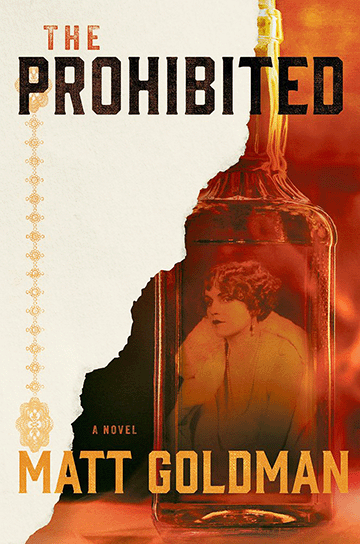
A Jewish woman as a killer? How can you not keep reading?
Goldman, whose previous clever books starred the oddly named detective Nils Shapiro, has mastered the mystery writer’s skill of leading you to think you understand what’s happening, only to surprise you later that you’re wrong.
And he’s astonishingly adept at creating characters so different you’d think they’d never even meet and spinning them into a circle of circumstances and relationships in a book that has more twists and turns than a mountain switchback.
In The Prohibited, Goldman puts his mystery-writer talent into a novel. It features Jews in 1922 St. Paul, where the Volstead Act — named for its chief sponsor, Rep. Andrew Volstead, a Republican from Granite Falls, Minnesota — has created Prohibition, killing the Kaner brothers’ successful liquor store.
To make a living, the brothers pursue different paths. Frederick (Red) goes to work for an upscale men’s clothing store and enjoys it more than selling booze.
His cellar holds more than 200 cases of Dougherty’s Private Stock rye whiskey — hidden in Hires Root Beer cases. He figures Prohibition won’t last long. Lewis does theater and is writing a play.
Isaac, the oldest and shortest, grows a bushy black beard, dresses hat-to-shoes in black and lets people think he’s a rabbi. That keeps him semi-openly in business under the law’s exception for sacramental wine.
Loosely based on Goldman’s family history, The Prohibited includes not only the prohibition against liquor but what then were pretty much prohibited relationships besides criminal: homosexual, Jewish-gentile and Black-white.
There’s no good way to describe the plot without giving away its many surprises, but describing the other main characters gives an idea.
Red’s petite wife, Emma, feels neglected, her husband put off by her work for women’s suffrage because it was aligned with prohibitionists that included the Ku Klux Klan.
They have four children. Ben and Sarah are the youngest, twins Rose and Willie are young adults. Intelligent, very capable Rose wants to go to medical school but Red doesn’t buy the idea of woman physicians, so she moves to Michigan’s Upper Peninsula to work in her grandfather’s clothing store for tuition money.
She’s also getting away from a would-be romance with Catholic Marco Franzoni, with whom a future seems impossible.
Handsome Willie regularly charms the pants off women, but his main interest is money. He works for Herschel King — bootlegger, speakeasy and casino owner.
Pearl Holgersen, who is of mixed race, Black and white, was abandoned by her white mother at age seven and adopted by Joe Holgersen and his wife. He owns a bar in Hinckley, getting liquor from Chicago. They raise and educate Pearl, an avid reader who works in the bar.
But Willie has been selling booze on the side of his job with Herschel. Marco and the poorly mannered Sherman Lefkowitz — who’s not very bright — have been sent to deal with him.
Fearing for Willie’s life, his parents decide to fake his death. Red’s uses Dougherty’s to bribe a detective, a physician for the death certificate and an undertaker. Red and Emma send Willie away to Rose.
During Willie’s business trips to Hinckley, he had seduced Pearl, who pines for him.
Goldman entwines these very different people with creativity, descriptions and good writing. For example:
“The Canadian said he’d dock at the marina … the first Sunday of each month. At least until November when Lake Superior churned gray and frigid, increasing its appetite for ships and men.”
Goldman gives affectionate descriptions of 1920s St. Paul, including speakeasy caves along the Mississippi, the Commodore Hotel, St. Paul street names and the now-lost Rondo neighborhood, where Pearl lands after a death sends her fleeing Hinckley.
It is a revelation.
“In her 18 years, Pearl had never lived with people who looked like her” or imagined such a place existed.
“Negro-owned boutiques, hardware stores, greengrocers, and butcher shops. Offices of Negro doctors, lawyers, insurance agents and newspapers like the St. Paul Appeal.”
Unlike in white Hinckley, “in Rondo, people looked at Pearl for Pearl. Not because she was Black.”
For a Minneapolis guy, Goldman is versed in St. Paul’s geography and history, including brothel owner Nina Clifford and Police Chief John O’Connor, who made St. Paul a haven for criminals so long as he was paid off and the crimes were committed outside of the city.
The Prohibited is a delight as its characters’ lives intersect and the unexpected twists and surprises accelerate with each chapter. It’s hard to quit turning the pages.
***
Neal Gendler is a Minneapolis writer and editor.
(American Jewish World, November 2026)