






Reviewed by NEAL GENDLER
There’s no straight line between the Venice and Warsaw ghettos, says historian Alexander Lee in The First Ghetto.
Beyond a separating fence, there’s little similarity. The Nazis intended to kill Jews. Venice intended to prevent the city’s Christians from contamination by Jews.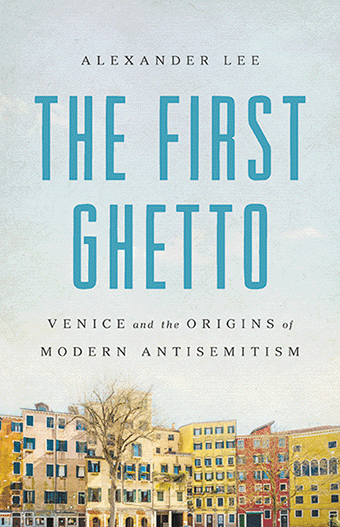
But Venice’s Jews were important for trade and lending, so how to reconcile distaste with necessity? “If Jews could neither be expelled nor allowed to go on living freely, the only other option was to confine them,” Lee says.
“No one seems to have objected to the idea of confinement,” he says, but the question was where. Jews needed to be close enough to Venice to do business there.
“What makes the Venetian Ghetto so historically important is not its originality,” says Lee, of Warwick University and author of five previous acclaimed books.
Since at least the 13th century, Jews throughout Europe had lived in specific neighborhoods, inside barriers and iron gates, he says. But while Venice Ghetto gates were locked at night, and housing was small and crowded, Jews were not starved, beaten, forbidden to go out or systematically killed.
Perhaps Venetians hated Jews less than the Nazis did, but perhaps more important, they were vital to that Italian port city’s economy.
“The significance of the Venetian Ghetto lies in its name,” Lee says, supplying the name’s origin and its appropriation in modern times for other reasons.
Three Venetian ghettos were created, with distinct characteristics, on an island made by canals. For the leading advocate of segregating the Jews, “it could hardly have been better.”
The Ghetto’s existence was “intended to be a temporary expedient,” Lee says. “The expectation that sooner or later the city’s Jews should be made to leave was getting hard to ignore.” But previous rules, including about banking, created no legitimate way to kick the Jews out.
The ghettos were “crowded, unsanitary and marred by privation,” Lee says. Residents endured petty restrictions and hostility.
Still, Lee says, the Jews not only survived but at times thrived, administering their own affairs; negotiating with government authorities; creating music, theater and a major publishing industry; and building “eight glittering synagogues” for Ashkenazim and Sephardim. We get a color photo of the inside of one.
Jews imported fabrics, spices and other goods from the Levant, helping make Venice a major trading hub.
Perhaps most important, Jews were essential as lenders to a population that considered lending at interest a sin. The government regulated interest rates. Jews also were major traders in second-hand goods.
Ghetto is very clearly and well written. Its main body of 315 pages would have been enlivened by some first-person accounts, but we can’t expect that from centuries ago.
Lee uses many Italian words and translates them, but a glossary would have been helpful when the words reappear scores of pages later. Or he could just have continued with the translated terms.
He follows the history of Venice and the rise and fall of ghetto Jews’ fortunes through several centuries. Readers’ patience may be taxed by many pages about financially exhausting wars among factions on the Italian peninsula, including the Vatican, and invasions from Austria and France.
Their relevance is that “after many years of war, even the Jews’ fiercest critics had come to recognize that they were necessary — even essential.” The most that could be done was to make Jews’ lives unpleasant with restrictions.
“Only the Jews could offer the unique combination of taxes, loans and cheap credit that the Venetians so needed,” even though their contribution to the treasury “probably never amounted to more than a few percent of the city’s annual income.”
Jews and Christians did interact, but at one point, Jews were required to wear a yellow badge. Later, a yellow hat. Christians’ belief that Jews were a threat to people’s Christianity is laughable considering which religion proselytizes.
After 1600, “the Ghetto was entering its golden age,” Lee says. “Pragmatism had eclipsed prejudice, and mere tolerance was beginning to shade off into benign acceptance. Within the bounds of an increasingly porous confinement, everything possible was done to nurture Jewish life.
“Religious freedom was assured for all professed Jews, commerce was encouraged and shy of citizenship itself, every legal protection was accorded to the Ghetto’s inhabitants.”
Jews flocked to the city.
“By 1630, Venice was the best place in the world to be a Jew.”
As the Ghetto thrived, its population had surpassed 3,000, with Jews arriving from Spain, Portugal and elsewhere in Italy. That increased pressure on housing and hygiene, Lee says. “By1609, so much waste was already being produced that it posed a danger to public health.”
Shops also multiplied, most tending to attract a specific community. For example, “‘Levantine’ Jews almost never bought food from ‘German’ shops, and vice versa.”
While some Jews w ere wealthy enough to dress impressively, poverty existed and there were times of privation. Jews created charities.
Late in the 1600s, Venice was financially strapped. Wealthy Jews left for other cities and the ghetto became poorer, “tired and shabby.” In 1723, “the ghetto was effectively bankrupt.”
Conquest by Napoleon, in 1797, freed Jews from legal discrimination, and the ghetto gates were removed. But twice Austria ruled, reimposing restrictions. Austrians improved the ghetto’s buildings, destroying the worst, but many Jews had left and “the ghetto was becoming a shell,” Lee says.
In 1848, Venetians revolted and the government declared total equality. Austrians returned the next year, but by 1866, they were gone and King Vittorio Emanuele II entered, head of a united Italy.
Jews were jubilant, a rabbi saying Jews had been raised “to the level of our beloved fellow citizens.”
***
Neal Gendler is a Minneapolis writer and editor.
(American Jewish World, October 2026)