




You never know when you’ll encounter something Jewish along the highway.
During a March vacation in southern Arizona, my wife, Maj-Britt, and I made a day trip to Tombstone, the storied Old West town.
We did some touristy things, including attending a reenactment of the “Gunfight at the O.K. Corral” — the actual shootout took place Oct. 26, 1881. After an initial shooting and interminable dialogue between Wyatt Earp, his brothers and Doc Holliday and inebriated members of the Clanton gang — aka the Cochise County Cowboys — the serious faux gunplay commenced.
Editorial
When the dust settled, three of the cowboys lay dead. They were buried in the Boothill Graveyard. (Cowboys, the gangsters of yesteryear, were buried with their boots on.) After strolling through Tombstone and visiting the office of The Tombstone Epitaph, an interesting local history museum, we got back in our Mitsubishi Outlander Sport rental and motored to Boothill. A large sign at the entrance announces: Welcome to Boothill Graveyard and Jewish Memorial.
After reading some of the markers in the compact cemetery (“Here lies George Johnson / Hanged by mistake 1882 / He was right / We was wrong / But we strung him up / and now he’s gone”), I walked down a rocky path to the Jewish memorial.
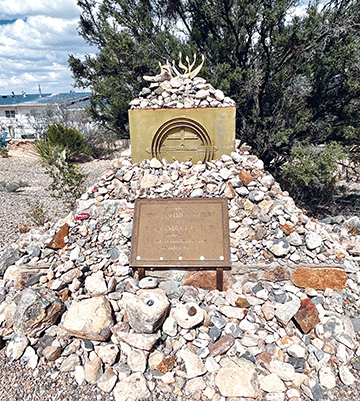
Like Hebrew Hill (Mount Zion) cemetery in Deadwood, South Dakota, the section for former Jewish residents of Tombstone and Cochise County is set apart from the main graveyard.
“In the 1980s, the neglected Jewish section of Boothill came to light, and the Jewish Friendship Club of Green Valley began efforts to restore the cemetery,” according to Atlas Obscura. “In 1991, a memorial to the Jewish Pioneers and Indian Friends was dedicated along with the reopening of this section of the famous cemetery. The two-tiered monument is made of rocks gathered from the mountains of Arizona.”
One more Jewish angle on Tombstone: Near the actual site of the gunfight (not the nearby theater for the reenactment), there is the display of a “prostitute crib,” a furnished mini bordello. On the wall is a photo of Josephine “Sadie” Earp (née Marcus), Wyatt Earp’s common-law wife — his fourth wife. In the photo, she’s wearing a revealing gown.
“The third of four children, Josephine Sarah (Marcus) Earp was born in Brooklyn, New York, in 1861 to German-Jewish immigrants Sophie and Hyman (Henry) Marcus,” as per an entry in the Jewish Women’s Archive. “When she was seven years old, the family moved to San Francisco. In 1879 the Pauline Markham Theater Company came to town, and Josephine slipped away with the troupe. In the Arizona Territory, she fell for Johnny Behan, a divorced, bankrupt politico. Her family retrieved her, but Johnny followed and convinced her gullible parents of his honorable intentions. In May 1880, she joined him in Tombstone, Arizona, but they did not marry.”
Josephine Earp then left Behan for “thirtyish, tall, handsome and laconic Wyatt Earp.” A Wikipedia entry notes that there is “some evidence that she lived from 1874 to 1876 in Prescott and Tip Top, Arizona Territory under the assumed name of Sadie Mansfield, who was a prostitute, before becoming ill and returning to San Francisco.”
There are many colorful stories from the Wild West.
Touristing is hard work and builds one’s appetite. On the trip back to Tucson, our main base on vacation, we stopped for lunch at Los Milics Vineyards in the town of Elgin.
Arizona wine, who knew?
The tasting room in the middle of nowhere in the foothills of the Mustang Mountains is a striking, architect-designed edifice surrounded by slabs of Corten steel, the material that rusts to a reddish hue. Maj-Britt ordered a flight of wines from the vineyard, which also operates a restaurant in downtown Tucson and a tasting room in Scottsdale.
It was gusty outside, so we sat inside the restaurant and gazed out at the 80-acre vineyard and nearby casitas for rent (all booked up). I’m not a wine aficionado and was driving, so I just sampled the flight of wines that my wife ordered. The food was tasty, too.
According to the Los Milics website, the co-proprietors of the business are Pavle Milic and Mo Garfinkle. As it happens, Garfinkle is deeply involved in the Arizona Jewish community and is on the board of Hillel at Arizona State University in Tempe. Other highlights of our Arizona vacation included visits to Casa Grande Ruins National Monument, Saguaro National Park and the San Xavier del Bac Mission Church.
(In the way of a travel tip, two years ago, on a visit to Joshua Tree National Park in California, I opted to buy a National Park Service senior lifetime pass for $80. The pass is good for the occupants of a car, and I’ve used it to visit Badlands National Park, Devil’s Tower National Monument, Saguaro National Park, etc. It’s a good value for travelers.)
The focal point at Casa Grande Ruins National Monument, which is free to visitors, is the “Great House,” which dates to 1350 C.E. It was part of an extensive settlement of communities that used irrigation canals for farming. The ancient residents are sometimes referred to as the “Hohokam,” but it’s not the actual name of a tribe or people. The preferred terminology for the residents of the area is “Ancestral Sonoran Desert People.”
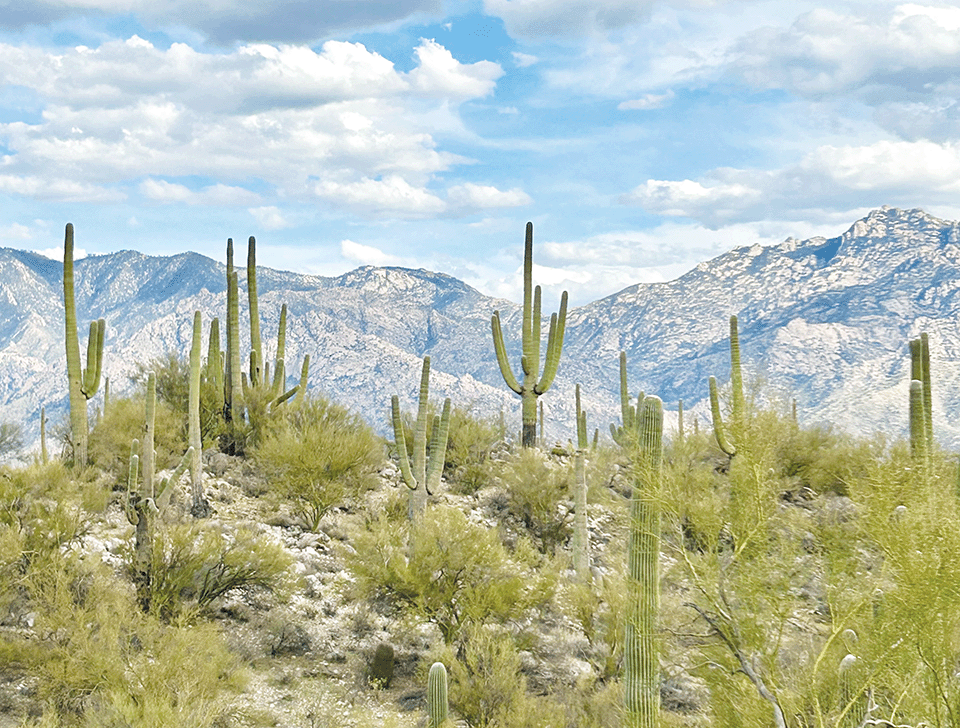
At Saguaro National Park, we entered on the west side of the sprawling desert preserve, by the Rincon Visitor Center. We went on an easy, level hike on the Mica View Trail. At Javelina Rocks on our loop through the park, Maj-Britt opted to stay by the car while I hiked a bit and climbed up on a rock for a better view. She calls me the “mountain goat.” The desert vistas are beautiful.
Apart from my 30-year tenure at the Jewish World, I’ve been writing for various American Indian publications for nearly 50 years. Scoping out events around Tucson, I found that a powwow was scheduled at the San Xavier del Bac Mission, on the San Xavier reservation south of Tucson. So, we hit the highway to San Xavier; however, the powwow was inexplicably canceled. The church, which dates to 1797, was packed for a mass. We wandered around the area, with vendors selling food — fry bread, tacos and lemonade — and craft items, then returned to visit the ornate interior of the church.
I last visited this area in 1982, when the Tohono O’odham Nation hosted the International Indian Treaty Conference, an annual gathering sponsored by the American Indian Movement (AIM). I attended several of these conferences in the 1980s, in Montana, Minnesota, Oregon and South Dakota. Forty years ago, the Tohono O’odham Nation, which is on the U.S.-Mexico border, was called the Papago Reservation. It has now reverted to its traditional name. A friend told me that Tohono O’odham translates to “shimmering desert people.”
As I’ve noted before, Maj-Britt and I occasionally encounter some hiccups during our travels. Returning to the Twin Cities from Phoenix was a doozy.
We left Phoenix Sky Harbor Airport on the evening of March 10. I surprised my wife by upgrading our basic economy tickets to first class — it was a pretty good deal. So, ensconced in our cozy seats, enjoying wine in a real glass and warm mixed nuts, we flew above the clouds. For about 30 minutes.
The pilot then came on the intercom and implored everyone in the cabin to listen up: We were returning to Phoenix. There was a monster storm in Chicagoland, hail and tornados. O’Hare diverted flights to MSP, which then put out the word that it would not take any more incoming flights. So, our American Airlines jet did a U-turn — flightus interruptus.
Since we were at the front of the plane, row one, upon arrival at PHX I went back to the ticket counter and rebooked our tickets for the following night. (I rejected the option of a later flight to Charlotte, North Carolina, and then on to MSP, which would have arrived at 9:30 the next morning — about 12 hours in all.) And I booked a room at a hotel near the airport, Country Inn and Suites by Radisson. Of course, the airline did not help with the lodging expense.
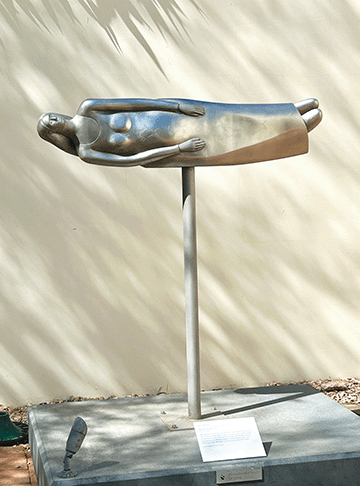
On the upside, March 11 was a beautiful day, 81 degrees in Phoenix. We spent the afternoon at the Heard Museum, looking at exhibits of Southwestern Indian art. And we had a delicious lunch in the museum’s courtyard restaurant.
Our Lyft drivers on that Wednesday were immigrants from Romania, Iraq and Mexico. The Iraqi driver inquired about my name, Mordecai, and then lifted his cap to reveal a small suede yarmulke — an Iraqi Jew. We had a spirited conversation: He didn’t like the idea of female rabbis and, as a boy, he resented his Jewish mother for imposing Judaism on him.
Our Mexican driver was quite familiar with the January ICE invasion of Minnesota and expressed his disapproval of the repression visited upon us. He said that he planned to return to Mexico.
On our drive from Tucson to Phoenix, we had passed by a sprawling ICE detention center near the town of Florence. The facility for men is a private prison owned by CoreCivic, formally the Corrections Corporation of America. Signs on the fence proclaimed that they were hiring.
***
While resting up in our hotel rooms in Phoenix and Tucson, we watched some cable news shows. The U.S.-Israeli war on Iran was raging. It’s into its fifth week now. Trump continues to make contradictory pronouncements about the aims and course of the “military operation.” I recall that Putin referred to his invasion of Ukraine as a “special military operation.” Trump is not an original thinker.
It was a little surprising to hear Trump proclaim that he and his gaggle of lackeys had no idea that Iran would retaliate by sending drones and missiles at U.S. bases in the region and hit facilities in the United Arab Emirates, Qatar, Iraq, Saudi Arabia, etc.
Unlike some of my friends and relatives in Israel who are cheering on the U.S. and Israel in this benighted war, I have no confidence that our president, who is in steep mental decline, will emerge from the conflict with anything that could be called a victory. But he likely will brand any outcome as a win and, perhaps, stage a victory parade.
In the meantime, he will continue construction of his lavish ballroom on the demolished site of the White House East Wing. He knows more about construction than anyone.
Mordecai Specktor / editor [at] ajwnews [dot] com
(American Jewish World, April 2026)