





• About
  • Support AJW
  • Jewish Community Directory
  • Subscription Information
  • Contact Us
American Jewish World
No Result
View All Result
  • News
    • All
    • Africa
    • Asia
    • Australia & New Zealand
    • Europe
    • Israel/Mideast
    • Latin America
    • Minnesota
    • US & Canada
    Esther Capp’s spirit lives on at Esther’s Table

    Esther Capp’s spirit lives on at Esther’s Table

    Local social services agencies to merge

    Local social services agencies to merge

    It’s time to submit entries for the 2025 AJW Hanuka Cover Contest

    It’s time to submit entries for the 2025 AJW Hanuka Cover Contest

  • Arts
    • All
    • Blue Box
    • Books & Literature
    • Music
    • Televison & Film
    • Theater & Performing Arts
    • Visual Arts
    These Jews were not toying around

    These Jews were not toying around

    A fighter in the Polish forest

    A fighter in the Polish forest

    Artworks by Rachel Leah Cohn create a mood of tranquility

    Artworks by Rachel Leah Cohn create a mood of tranquility

  • Lifestyle
    • All
    • Fashion
    • Food
    • Health & Wellness
    • Home & Garden
    • Travel & Culture
    Editorial: Arizona vacation during wartime

    Editorial: Arizona vacation during wartime

    Esther Capp’s spirit lives on at Esther’s Table

    Esther Capp’s spirit lives on at Esther’s Table

    Jewish Cubans survive the island’s economic collapse

    Jewish Cubans survive the island’s economic collapse

  • Editorial
  • Opinion
  • AJW Digital Archives
  • News
    • All
    • Africa
    • Asia
    • Australia & New Zealand
    • Europe
    • Israel/Mideast
    • Latin America
    • Minnesota
    • US & Canada
    Esther Capp’s spirit lives on at Esther’s Table

    Esther Capp’s spirit lives on at Esther’s Table

    Local social services agencies to merge

    Local social services agencies to merge

    It’s time to submit entries for the 2025 AJW Hanuka Cover Contest

    It’s time to submit entries for the 2025 AJW Hanuka Cover Contest

  • Arts
    • All
    • Blue Box
    • Books & Literature
    • Music
    • Televison & Film
    • Theater & Performing Arts
    • Visual Arts
    These Jews were not toying around

    These Jews were not toying around

    A fighter in the Polish forest

    A fighter in the Polish forest

    Artworks by Rachel Leah Cohn create a mood of tranquility

    Artworks by Rachel Leah Cohn create a mood of tranquility

  • Lifestyle
    • All
    • Fashion
    • Food
    • Health & Wellness
    • Home & Garden
    • Travel & Culture
    Editorial: Arizona vacation during wartime

    Editorial: Arizona vacation during wartime

    Esther Capp’s spirit lives on at Esther’s Table

    Esther Capp’s spirit lives on at Esther’s Table

    Jewish Cubans survive the island’s economic collapse

    Jewish Cubans survive the island’s economic collapse

  • Editorial
  • Opinion
  • AJW Digital Archives
No Result
View All Result
Morning News
No Result
View All Result
Home Arts Books & Literature

These Jews were not toying around

"Playmakers: The Jewish Entrepreneurs Who Created the Toy Industry in America," by Michael Kimmel, W.W. Norton and Co., 432 pages, $32.99

mordecai by mordecai
April 10, 2026
in Arts, Books & Literature
0
Share on FacebookShare on Twitter

Reviewed by NEAL GENDLER

Maybe I’m the only adult who didn’t know that Jews created and dominated the U.S. toy industry.

READ ALSO

A fighter in the Polish forest

Artworks by Rachel Leah Cohn create a mood of tranquility

Dolls especially — diaper-wetting dolls, crying dolls, talking dolls, Barbie dolls — and baseball cards, plastic toy guns, cap guns, action figures, Hot Wheels cars, hula hoops and model airplanes and ships. Comic books, too.
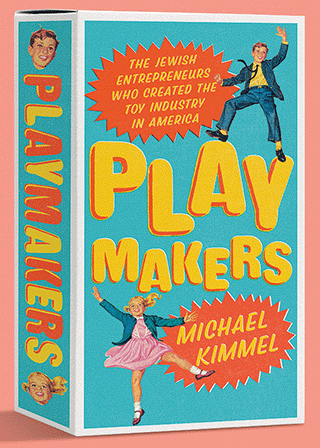
Well, now I certainly do, thanks to Michael Kimmel and his prodigious research for Playmakers.

(I did know about Barbie dolls.)

It’s risky to call a book definitive, but on this subject, I can’t imagine anything of manageable size that’s more inclusive.

In 368 pages plus acknowledgments, notes and index, Playmakers covers not only toys but the changes in American life that created a market for them, the East European immigrant and first-generation Jews who created and sold them, and the antisemitism leading to comic-book superheroes.

Among the world’s top 10 toy companies are Hasbro and Mattel, “or their wholly owned subsidiaries like Barbie, Fisher-Price, Nerf and Hot Wheels,” Kimmel says. Toy companies and their 1900s founders whom Kimmel calls “Yiddish Jews” (distinct from the earlier-arriving, more Americanized German Jews) “created both the idea and material reality of childhood that came to dominate — indeed, to define — the world of children for the rest of the 20th Century.”

To that huge assertion, Kimmel adds that those Jews “didn’t particularly set out to change the culture. Rather, they were trying to find a place where they might fit in.”

He begins with his Russian-born great-uncle, Morris Michtom, captivated by a newspaper cartoon showing President Theodore Roosevelt on a failed bear hunt. Michtom — born Moshe Michael Charmatz — suggested that his wife Rose create a small stuffed bear in the back room of their Brooklyn candy store in 1902.

He displayed his “Teddy bear” in a store window. Customers soon were asking to buy one. That led to hiring yeshiva boys to make them, then to industrial production and years later, a huge hit, the Shirley Temple Doll. Playmakers began as “a modest family memoir,” Kimmel says. “But as often happens with small projects, when you open one door, suddenly dozens of other ones reveal themselves. “The project sent me sprawling into a forest that kept getting deeper and thicker.” So is the book, which is interesting and breezily written, with clever asides, but not a quick read. It is packed: page after page of information I suspect few of us knew and Jews, Jews, Jews.

Yes, we knew that Jerry Siegel and Joe Shuster, two shtetl-immigrant sons in suburban Cleveland, created Superman in 1934. Kimmel and others say Superman, originally named Kal-El — which Kimmel translates as “all that God is” — is a Jew who disguises himself as the milquetoast gentile Clark Kent but uses superpowers to do good at a time when Jews were being persecuted.

Kimmel quotes Jewish cartoonist Jules Feiffer as saying that Superman didn’t really come from Krypton: “It was the planet Minsk.”

Kimmel says the heyday of comic books was 1938 to the mid-1950s. In 1940, “the typical American child purchased an estimated 7.5 comic books a month,” and “the entire world of superheroes was a virtual Jewish ghetto” — artists frozen out of architecture and advertising.

Toy distribution was a Jewish business, with Jewish distributors and Jewish salesmen selling to Jewish department store owners. Toys ‘R’ Us was founded by Charles Lazarus.

Playmakers would be worthy enough just as a history of toy companies and their Jewish creators, but with admirable thoroughness, Kimmel provides an overview of Jewish immigrants as social outsiders making their own way and the development of the concept of childhood.

More than a century ago, children often were put to work as a family economic asset. But with urbanization and the development of a growing middle class, he says, the concept of “childhood” grew, soon to be expanded to recognize a new phase, adolescence.

Kimmel gives a detailed, well-resourced explanation of how such social changes created the need for toys and books to fill children’s time and engage their minds. First generation “Yiddish Jews” and their offspring — who mostly grew up poor and toyless — seized on that need, filled it and prospered.

Michtom’s Ideal Toy is one example. Under son Ben, it created a much-lauded black doll that untimely failed, partly because of material defects. Ruth Handler (née Moskowicz) invented the Barbie doll and, with husband Isadore, turned a plastic picture-frame company into toy giant Mattel. Another industry giant, Hasbro, is named for founding brothers Hillel, Herman and Harry Hassenfeld.

And the very popular electric trains? Lionel was the middle name of Joshua L. Cohen.

We learn of a later success by two Germans. Hans Augusto Reyersbach and wife Margarete, Jews from Hamburg, Germany, fled Paris on bicycles in 1940, carrying drawings for an impish monkey named Fifi. After Spain, Portugal and Brazil, they reached New York, where Hans became H.A. Rey, Margarete became Margret and Fifi became Curious George, which, Kimmel says, “heralded the explosion of children’s books in the postwar era.”

At the end, Kimmel summarizes: “First-generation Jews were central to the creation of contemporary childhood,” providing the toys, dolls, games, puzzles and “the ideological apparatus to support it: the advice books for anxious parents,” advice columns and the fields of child and developmental psychology.

In their 20th-century struggle to assimilate, he says, “they stood out, transforming the culture they sought to embrace.”

***

Neal Gendler is a Minneapolis writer and editor.

(American Jewish World, April 2026)

Related Posts

A fighter in the Polish forest
Books & Literature

A fighter in the Polish forest

March 22, 2026
Artworks by Rachel Leah Cohn create a mood of tranquility
Visual Arts

Artworks by Rachel Leah Cohn create a mood of tranquility

March 22, 2026
Director Ben McGovern reflects on ‘The Happiest Man on Earth’
Theater & Performing Arts

Director Ben McGovern reflects on ‘The Happiest Man on Earth’

January 18, 2026
The Cookers return to Minneapolis
Music

The Cookers return to Minneapolis

January 16, 2026
Local author remembers his father’s struggle against Nazism
Books & Literature

Local author remembers his father’s struggle against Nazism

November 19, 2025
It’s time to submit entries for the 2025 AJW Hanuka Cover Contest
Visual Arts

It’s time to submit entries for the 2025 AJW Hanuka Cover Contest

November 17, 2025

Leave a Reply Cancel reply

Your email address will not be published. Required fields are marked *

RECENT ARTICLES

These Jews were not toying around

These Jews were not toying around

April 10, 2026
Editorial: Arizona vacation during wartime

Editorial: Arizona vacation during wartime

April 10, 2026
A fighter in the Polish forest

A fighter in the Polish forest

March 22, 2026
Artworks by Rachel Leah Cohn create a mood of tranquility

Artworks by Rachel Leah Cohn create a mood of tranquility

March 22, 2026
Editorial: Our newspaper business 20 years on

Editorial: Our newspaper business 20 years on

March 18, 2026

About

Since 1912 the AJW has served as an important news resource for the Jewish community. The Jewish World unites the main Jewish communities in St. Paul and Minneapolis, as well as those in Duluth, Rochester and smaller cities, and bridges the divides between the various Jewish religious streams.

Quick Links

  • About the AJW
  • Advertising Information
  • Submission Guidelines
  • Subscription Information
  • Jewish Community Directory

Contact Us

The American Jewish World
3249 Hennepin Ave., Suite 245
Minneapolis, MN 55408

Tel: 612.824.0030 / Fax: 612.823.0753
editor@ajwnews.com

  • Buy JNews
  • Landing Page
  • Documentation
  • Support Forum

© 2026 JNews - Premium WordPress news & magazine theme by Jegtheme.

No Result
View All Result
  • Home
  • News
  • Food
  • Health & Wellness
  • Lifestyle
  • Opinion
  • About the AJW
  • Jewish Community Directory
  • Support AJW
  • Subscription Information
  • Contact Us

© 2026 JNews - Premium WordPress news & magazine theme by Jegtheme.