
By MAHDI WARSAMA
The Dec. 14 mass shooting in Australia by hateful individuals targeting a Jewish Hanuka celebration at Bondi Beach; President Trump’s disparaging remarks about the Somali community and other immigrants; and the rise of brazen right-wing antisemitism and Islamophobia in the United States, and in other countries around the world, are very concerning for both the Muslim and Jewish communities in the West.
History teaches us that when hate groups target one minority community, it is just a matter of time until they target another minority community. Discriminatory prejudice has only one rule: othering or exclusion. Once they accuse you of being different based on the color of your skin, your religion or your social status, discriminatory actions will follow.
In other words, any individual or group that has antisemitic bias is very likely Islamophobic and vice versa. Discrimination and prejudice are forms of creed. You either believe it or you don’t.
It is evident from the famous quotation by German pastor Martin Niemöller, “First they came for the socialists, and I did not speak out — because I was not a socialist. Then they came for the trade unionists, and I did not speak out — because I was not a trade unionist. Then they came for the Jews, and I did not speak out — because I was not a Jew. Then they came for me — and there was no one left to speak for me.” This quotation describes the reality of the ascendant forces of hatred in every generation.
This reality alone should compel both Jewish and Muslim communities in the U.S. to recalibrate their relationship and confront the common threat they face together rather than separately. It is very unnerving that both communities see their relationship through the lens of the geopolitical conflict in the Middle East — or the Israeli-Palestinian conflict, to be precise.
While the Israeli and Palestinian conflict issue is critical to both communities, making it the only problem that defines the relations of the two monotheistic religious minority communities is a strategic mistake in my opinion. There are more pressing issues in the U.S. that require collaboration. Each community has its own strengths to contribute.
The Jewish community is a powerhouse in the fields of economics, politics and civil rights, with organizations such as the Anti-Defamation League (ADL), the American Jewish Committee (AJC) and dozens of others. And Islam is one of the fastest-growing religions in the U.S. and has a growing influence both politically and economically. Muslims also have their own civil rights organizations, such as the Council on American-Islamic Relations (CAIR) and the Muslim Public Affairs Council (MPAC). Joining forces and collaborating on civil rights issues, anti-discrimination programs and measures across the two communities requires courage and a change in the status quo.
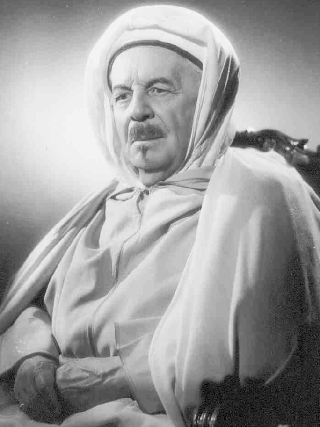
The collaboration between the two communities when they face a common threat and find themselves in the minority is not new. The two communities’ fates became intertwined when they were both expelled, executed or forced to convert to Christianity during the expulsion of the Islamic Moors from Iberia (Al-Andalus), now Spain, by the Catholic monarchs after the fall of Granada in 1492. During the Nazi occupation of France, a Muslim imam, Si Kaddour Benghabrit of the Grand Mosque of Paris, helped Jews by giving them Muslim ID cards and refuge to save them from Nazi persecution and arrest. In the United States, in particular, Jewish civil rights organizations always support the rights of other minorities, including Muslims.
In brief, given the current political and civic environment, the two monotheistic religious minority communities must come together to discuss civil rights issues of concern to both. Engaging one another, creating pathways for collaboration and aggregating common interests are in the best interests of both communities.
***
Mahdi Warsama is the CEO of the Somali Parents Autism Network (SPAN), a nonprofit advocacy organization working with families with children diagnosed with developmental disabilities. He can be reached at mwarsama0 [at] gmail [dot] com.
(American Jewish World, Jan. 2026)